Archive
Texas Drought worst since 1895
 The drought in Texas, during March, was the worst since 1895.
That is about the time my parents were born 120 years ago.
I never thought it could be worse than the drought of the 1950s, but it is. Drive out into grazing country where mesquite aren’t too thick and all you can see is dry, cracked soil with an occasional fire ant or a gopher mound in the sandier soil.
Comparing the current drought with the seven-year drought in the 1950s, old-timers say the current drought sapped the soil of moisture faster than it did in the 1950s.
It just stopped raining last July, and pasture after pasture was hit by wildfires.
Right now, there is no potential to produce hay, harvest wheat or plant cotton or grain sorghum this May. Unless there is a week of rain fairly soon there is no hope for agriculture this year.
The Texas Ag Extension Service says that, despite a few recent showers in some areas, the cotton growing in Texas and Oklahoma is still in a drought. Any crop planted in southern Texas earlier in the year that got up out of the ground is now being sand blasted by hot, dry winds.
Wildfires have burned at least 1.5 million acres in the state since Jan. 1.
In addition to grazing losses, ranchers are facing rangeland stock water tanks that are dry or nearly dry. Streams are not flowing and lakes and big tanks are turning to deep mud.
Europe is facing the worst drought in century

Traditional Easter fairs in the east and the north of the Netherlands have been cancelled because of the risk of fires posed by the extraordinarily dry weather affecting northern Europe. In the eastern half of the country, one of Europe’s biggest traders, outdoor family barbecues, smoking and camp fires are a strict no-no.
In the Swiss canton of Zurich, officials began moving trout this week from the river Toess before their habitat dried up. This year threatens to bring “one of the most significant droughts since 1864,” the year when records began in Switzerland. The drought in western Switzerland over the last 12 months is as severe as those recorded in 1884 and 1921. Several cantons have also imposed bans on lighting fire in and close to forests. A grass shortage could also lead to a Read more…
Texas Wildfires Threaten Wheat Crop, Drive Food Prices Higher

As firefighters from around the country and the National Guard continue to battle the many blazes scattered across the state, with no immediate end to the crisis in sight, the future looks bleak for Texas farmers. Many farmers’ fields were already damaged by drought, and now some crops have been further harmed by smoke or entirely destroyed by flame.
Some agricultural experts are now predicting that Texas will lose two thirds of this year’s wheat crop to drought and Read more…
Fires and Drought Trouble Texas and Other US Plains States

Photo: Alberto Tomas Halpern
A volunteer firefighter fights a fire which began outside Marfa, Texas, and was carried by winds to nearby Fort Davis, April 9, 2011
Drought conditions and high winds have fueled destructive wildfires in northern Mexico and the southern U.S. plains states, especially Texas, where dozens of homes have burned in recent days. The dry weather is also having an impact on agriculture that is likely to cause some food prices to rise.
Fast-moving wildfires scorched around 32,000 hectares of land in the west Texas ranch country around Fort Davis on Saturday and Sunday, killing cattle and horses, and leaving pastures charred and smoky. The fires reached populated areas near Fort Read more…
Drought In Amazon Could Lead To Accelerated Global Warming
A new study reveals a drought last year in the Amazon basin caused the forest to lose significant levels of vegetation, which in turn could accelerate the pace of global warming.
The study, conducted by an international team of scientists and funded by NASA, uses specific satellite imaging data provided by the agency to draw its conclusions. The Moderate Resolution Imaging Spectroradiometer (MODIS) and Tropical Rainfall Measuring Mission (TRMM) satellites provided more than a decade’s worth of data for scientists who studied the de-vegetation of the Amazon rainforest.
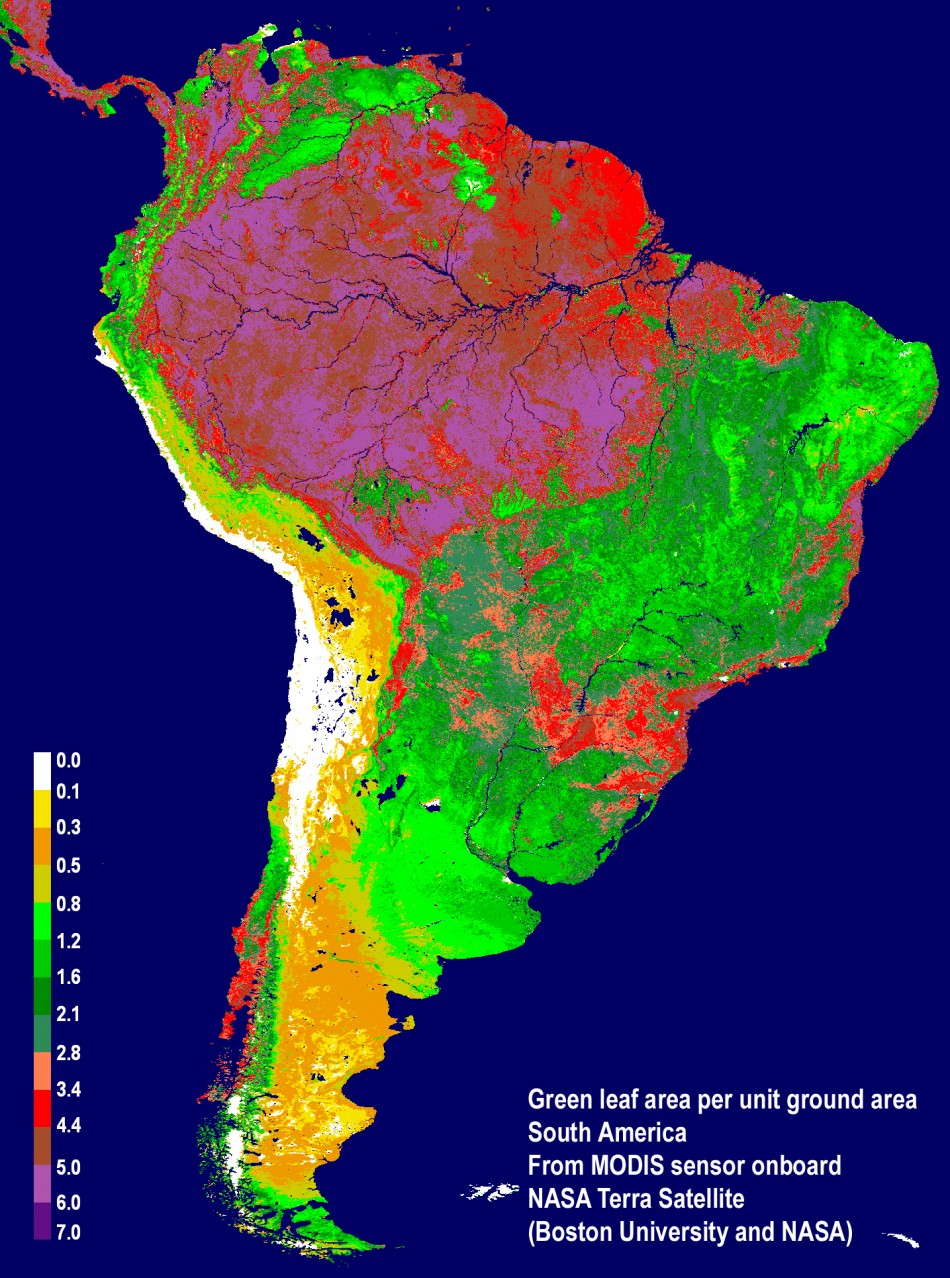
(Photo: NASA/BU) NASA satellite sensors, such as MODIS, showed an average pattern of greenness of vegetation on South America: Amazon forests which have very high leaf area are shown in red and purple colors, the adjacent cerrado (savannas) which have lower leaf area are shown in shades of green, and the coastal deserts are shown in yellow colors.


The scientists say changing climates with warmer temperatures and altered rainfall could lead to the rainforests turning into grasslands or woody savannas. This causes carbon stored in the rotting wood to be released into the atmosphere, which would add to the greenhouse gases present.
“The greenness levels of Amazonian vegetation — a measure of its health — decreased dramatically over an area more than three and one-half times the size of Texas and did not recover to normal levels, even after the drought ended in late October 2010,” Liang Xu, the study’s lead author from Boston University, said in a statement.
“The MODIS vegetation greenness data suggest a more widespread, severe and long-lasting impact to Amazonian vegetation than Read more…
The Causes of Rising Food Prices
 Food prices are rising quickly around the world. Part of the problem is weather. The winter wheat crop in China has been poor. Australia has suffered floods, while Russia has undergone a drought. The earthquake and tsunami in Japan, no doubt, will hammer the very intensive agricultural production of the limited arable land on that archipelago. Weather-related agricultural problems, however, balance out fairly quickly. Mythical “global warming” aside, weather has ups and downs, and farmers, who are smart folks, take that into account. The Soviet Union, whose vassal state the Ukraine was once one of the best farmlands on earth, never managed to feed its people well, because a communist-controlled economy destroys Read more…
The Oil-Food Price Shock
 When future historians attempt to trace the origins of the current turmoil in the Middle East, they will find that one of the earliest of the many explosions of rage occurred in Algeria and was triggered by the rising price of food. On January 5, young protesters in Algiers, Oran and other major cities blocked roads, attacked police stations and burned stores in demonstrations against soaring food prices. Other concerns—high unemployment, pervasive corruption, lack of housing—also aroused their ire, but food costs provided the original impulse. As the epicenter of youthful protest moved elsewhere, first to Tunisia and then to Egypt and other countries, the food price issue was subordinated to more explicitly political demands, but it never disappeared. Indeed, the rising cost of food has been a major theme of anti government demonstrations in Jordan, Sudan and Yemen. With the price of most staples still climbing—spurred in part by a parallel surge in oil costs—more such protests are bound to occur.
California water future called ‘bleak’
 |
by Staff Writers
Sacramento (UPI) Feb 24, 2011
Scientists say the water situation in California is “bleak” and the state needs to act to bolster its entire aquatic ecosystem.
“Our assessment of the current water situation [in California] is bleak,” says Ellen Hanak, a Public Policy Institute of California economist. “California has essentially run out of cheap, new water sources.”
The institute has released its findings in a publication written by a team of scientists, engineers, economists and legal experts from three University of California campuses and Stanford University, AAA ScienceMag.org reported Thursday.
Their report says water quality is deteriorating, pollution from agricultural runoff is increasing, and efforts to manage water and species recovery are Read more…
China’s droughts nears worst in 200 years, adding pressure to world food prices
The recent unrest in the Middle East, which has been attributed, in part, to high food prices, gives us a warning of the type of global unrest that might result in future years if the climate continues to warm as expected. A hotter climate means more severe droughts will occur. We can expect an increasing number of unprecedented heat waves and droughts like the 2010 Russian drought in coming decades. This will significantly increase the odds of a world food emergency far worse than the 2007 – 2008 global food crisis. When we also consider the world’s expanding population and the possibility that peak oil will make fertilizers and agriculture much more expensive, we have the potential for a perfect storm of events aligning in the near future, with droughts made significantly worse by climate change contributing to events that will cause disruption of the global economy, intense political turmoil, and war. Read more…
Inflation in China rises as food prices soar

In January, the price of fresh fruit soared by 34.8 percent over a year earlier, while eggs rose 20.2 percent, the National Bureau of Statistics reported.
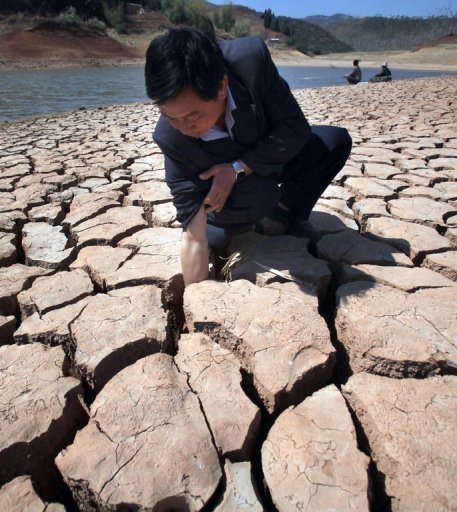
Adding to a squeeze on food supplies, China’s wheat-growing northeast is in the grip of a severe drought that threatens its crop. Beijing has launched a $1 billion emergency campaign of cloud-seeding to induce rains and expanded irrigation.
Also in January, inflation that so far has been confined mostly to food began to spread to Read more…


![[Most Recent Quotes from www.kitco.com]](https://i0.wp.com/www.kitconet.com/charts/metals/gold/t24_au_en_usoz_2.gif)
![[Most Recent Quotes from www.kitco.com]](https://i0.wp.com/www.kitconet.com/charts/metals/silver/t24_ag_en_usoz_2.gif)

 crisisboom
 CRISISBOOM

You must be logged in to post a comment.