Archive
Monster Storm Rearranges Saturn Before Our Eyes

The best views yet of a giant, once-in-a-generation storm on Saturn are now emerging, revealing how such tempests disrupt the ringed planet and create hot spots and cold vortexes, researchers say.
These findings could shed new light on the behavior of giant planets orbiting both alien stars and our sun. [Photo of Saturn’s huge storm]
The atmosphere of Saturn normally appears calm, but about once per Saturn year — equal to about 30 Earth years — the giant world is gripped by a titanic storm as spring comes to its northern hemisphere. The current monster Saturn storm erupted last Dec. 5.
“This disturbance in the northern hemisphere of Saturn has created a gigantic, violent and complex Read more…
Explosive Solar Eruption May 10th
Warm Water Causing Cold Winters
 This map shows sea‑surface temperatures averaged over eight days in September 2001, as measured by NASA’s Terra satellite. Dark red represents warm water (32 degrees Celsius) and purple is cold (‑2 degrees Celsius). The Gulf Stream can be seen as the orange strip extending from the eastern U.S. toward the Atlantic.
Imagine this: you are standing outside in New York City while waiting for a cab. It is in the winter and you are likely freezing. What if you were doing the same thing, but in Porto, Portugal?
Porto shares the same latitude at the Big Apple, but in Portugal you would be about 10 degrees warmer.
This happens for the northeastern coast of the U.S. and eastern coast of Canada. This is also true in other parts of the world. When the northeastern coast of Asia is colder, the Pacific Northwest is warmer.
Researchers at the California Institute of Technology have found an explanation. The culprit is warmer water off the eastern coasts of Read more…
Bad News from NASA: Proof That Comet Elenin Is Affecting Earth
 |
| Dees Illustration |
Dr. Mark Sircus, Contributing Writer
Activist Post
This is going to be the most extraordinary communication so fasten your seatbelts; we are in for a rough ride. I have known in my heart for months that I would have to make a communication like this but had no idea it would be this soon. Back in January, while investigating the underground city that is alleged to have been built under the new Denver Airport, reported on by the former governor Jesse Ventura, I put the puzzle together and came to the conclusion that a planetary event was in store for us in 2012.
Today I am presenting rock solid information; it does not get any better when NASA is your source. What you are about to read and see is happening. Last night, looking at a NASA mathematical model of comet Elenin, I found out that a large celestial body has already penetrated the solar system and is on course for a near and possibly horrific encounter with the earth in the fall of 2011. What we do not know is the size and mass of comet Elenin though I have no doubt that it is known by Read more…
China unveils rival to International Space Station
Less than a decade ago, it fired its first human being into orbit. Now, Beijing is working on a multi-capsule outpost in space. But what is the political message of the Tiangong ‘heavenly palace’?
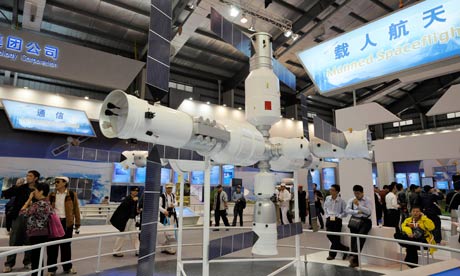 Visitors to the Airshow China exhibition look at a model of the Tiangong-1 space station. Photograph: Ranwen/Imaginechina
China laid out plans for its future in space yesterday, unveiling details of an ambitious new space station to be built in orbit within a decade.
The project, which one NASA adviser describes as a “potent political symbol”, is the latest phase in China’s rapidly developing space programme. It is less than a decade since China put a human into orbit for the first time, and three years since its first spacewalk.
The space station will weigh around 60 tonnes and consist of a core module with two laboratory units for experiments, according to the state news agency, Xinhua.
Officials have asked the public to suggest names and symbols for the unit and for a cargo spacecraft that will serve it.
Professor Jiang Guohua, from the China Astronaut Research and Training Centre, said the facility would be designed to Read more…
‘Houston, we have a problem’: $500,000 of high-tech equipment goes missing at NASA in a year
They might be able to send men into outer space – but it seems NASA can’t stop losing cameras, televisions and computers at its offices on the ground.
The U.S. space agency lost almost $500,000 of high-tech equipment at Kennedy Space Center in Florida last year, including a Vidge digital recorder worth $100,391.
Other items lost since 2008 include 11 Motorola handheld radios worth $35,582, a $18,000 wave reflectometer that checks for breaks in wiring and a $3,379 golf cart.
 Lost property: Read more…
Solar Activity Heats Up
April 14, 2011: If you’ve ever stood in front of a hot stove, watching a pot of water and waiting impatiently for it to boil, you know what it feels like to be a solar physicist.
 NASA’s Solar Dynamics Observatory recorded this X1.5-class solar flare on March 9, 2011. [movie]
Back in 2008, the solar cycle plunged into the deepest minimum in nearly a century. Sunspots all but vanished, solar flares subsided, and the sun was eerily quiet.
“Ever since, we’ve been waiting for solar activity to pick up,” says Richard Fisher, head of the Heliophysics Division at NASA Headquarters in Washington DC. “It’s been three long years.”
Quiet spells on the sun are nothing new. They come along every 11 years or so—it’s a natural part of the solar cycle. This particular solar minimum, however, was lasting longer than usual, prompting some researchers to wonder if it would ever end.
News flash: The pot is starting to boil. “Finally,” says Fisher, “we are beginning to see some action.”
As 2011 unfolds, sunspots have returned and they are crackling with activity. On February 15th and again on March 9th, Earth orbiting satellites detected a pair of “X-class” solar flares–the most powerful kind of x-ray flare. The last such eruption occurred back in December 2006.
Another eruption on March 7th hurled a billion-ton cloud of plasma away from the sun at five million mph (2200 km/s). The rapidly expanding cloud wasn’t aimed directly at Earth, but it did deliver a glancing blow to our planet’s magnetic field. The off-center impact on March 10th was enough to send Northern Lights spilling over the Canadian border into US states such as Read more…
Cosmic burst in distant galaxy puzzles NASA

This NASA image from Swift’s Ultraviolet/Optical (white, purple) and X-ray telescopes (yellow and red) were combined in this view of a cosmic burst at the center of distant galaxy that has burned for more than a week, longer than astronomers have ever seen before, the US space agency said Thursday.
NASA is studying a surprising cosmic burst at the center of distant galaxy that has burned for more than a week, longer than astronomers have ever seen before, the US space agency said Thursday.
Calling it “one of the most puzzling cosmic blasts ever observed,” NASA said it has mobilized the Hubble Space Telescope along with its Swift satellite and Chandra X-ray Observatory to study the phenomenon.
“More than a week later, high-energy radiation continues to brighten and fade from its location,” NASA said in a statement.
“Astronomers say they have never seen such a bright, variable, high-energy, long-lasting burst before. Usually, gamma-ray bursts mark the destruction of a massive star, and flaring Read more…
NASA admits all previous warming trends caused by sun
I wonder what Al Gore’s rebuttal is going to sound like…
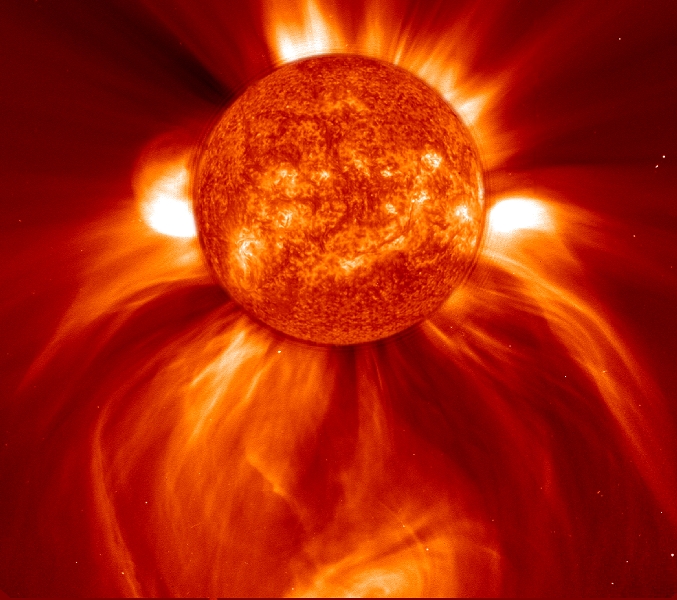 Under mounting pressure from scientists that reject the politically popularized man-made global warming and climate models—the Anthropogenic Global Warming (AGW) theory—the American space agency NASA has admitted that all past warming trends were driven by solar activity.
A victory for the man-made ‘global warming deniers’
As more scientists have joined the outcry over the politicization of Earth’s climate cycles—the current number exceeds 20,000—promoters of the AGW model have denounced the “global warming deniers” countering that little evidence supports the view that the sun is driving the observed warming trend.
Now, however, new study released from NASA’s Goddard Space Flight Center in Greenbelt, Maryland measuring the global temperature variance during the past 100 years has found the sun’s heat and variable cycles have indeed made a significant, measurable impact and greatly influenced Earth’s climate.
In fact, the influence extends as far back as the Read more…
Why Do These Breathtaking Russian Images of Earth Look So Different from NASA’s?

While this morning’s orbital image of Mercury is historic, these two images are the ones that have truly left me in complete awe today. Even more so than the most accurate, highest resolution view of Earth to date.
But unlike Blue Marble, these images are not by NASA. In fact, they look a lot different from NASA’s Earth imagery. Much better and crisper, some may say. But are they really better? Are they more accurate? NASA has explained to us why they look so different compared to their own.
The russians are back in the space race
It was taken by a Russian spacecraft, a new weather satellite called Elektro-L. It’s now orbiting Earth on a geostationary orbit 36,000 kilometers above the equator, after being launched on January 20 from the Baikonur Cosmodrome, on board a Zenit rocket.
This is the first major spacecraft fully developed in post-Soviet Russia, developed by NPO Lavochkin for the Russian Federal Space Agency. This is a major step in the country’s aerospace industry, after two decades of Read more…


![[Most Recent Quotes from www.kitco.com]](https://i0.wp.com/www.kitconet.com/charts/metals/gold/t24_au_en_usoz_2.gif)
![[Most Recent Quotes from www.kitco.com]](https://i0.wp.com/www.kitconet.com/charts/metals/silver/t24_ag_en_usoz_2.gif)

 crisisboom
 CRISISBOOM
You must be logged in to post a comment.