Archive
“FEMA Requests Millions of Rations For ‘Catastrophic Disaster In New Madrid Fault System’”

Huge coronal hole on Sun turning towards Earth
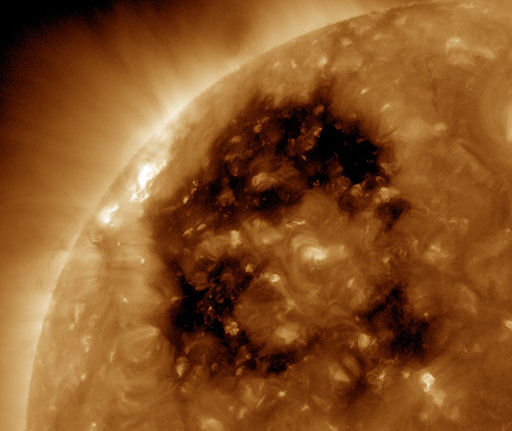
CORONAL HOLE: A dark croissant-shaped hole has opened up in the sun’s atmosphere, and it is spewing a stream of solar wind into space. NASA’s Solar Dynamics Observatory took this picture of the vast opening during the early hours of Jan. 30th. Researchers call this a “coronal hole.” Solar rotation is turning the coronal hole toward Earth. The stream of solar wind pouring from it will swing around and hit our planet in early February, possibly sparking polar magnetic storms. High-latitude sky watchers should be alert for auroras between Feb. 2nd and 4th. The coronal blast from the Sun storm’s arrival on Earth will coincide with a massive snow storm that will sweep across North America. –Space Weather
68 New Earths and 288 New Super Earths: The New Kepler exoplanet data – NASA videos and pictures
NASA press release on the 1202 new Kepler telescope exoplanets.
Exoplanets classified by size which are:
- 68 Earth-size exoplanets with a radius (Rp) of less than 1.25 Earth radius (Re)
- 288 super-Earth size exoplanets with 1.25 x Re < Rp ≤ 2.0 x Re - 662 Neptune-size exoplanets with 2.0 x Re < Rp ≤ 6.0 x Re - 165
Jupiter-size exoplanets with 6.0 x Re < Rp ≤ 15 x Re - 19
very-large-size with 15.0 x Re < Rp ≤ 22 x Re
“We went from zero to 68 Earth-sized planet candidates and zero to 54 candidates in the habitable zone – a region where liquid water could exist on a planet’s surface. Some candidates could even have moons with liquid water,” said William Borucki of NASA’s Ames Research Center, Moffett Field, Calif., and the Kepler Mission’s science principal investigator. “Five of the planetary candidates are both near Earth-size and orbit in the habitable zone of their parent stars.”
Kepler will continue conducting science operations until at least November 2012, searching for planets as small as Earth, including those that orbit stars in a warm habitable zone where liquid water could exist on the surface of the planet. Since transits of planets in the habitable zone of solar-like stars occur about once a year and require three transits for verification, it is expected to Read more…

Blast from the Sun
 |
| This still from SDO caught the action in freeze-frame splendor when the Sun popped off two events at once (Jan. 28, 2011). A filament on the left side became unstable and erupted, while an M-1 flare (mid-sized) and a coronal mass ejection on the right blasted into space. NASA/SDO/GSFC |
The sun unleashed two powerful solar eruptions today (Jan. 28) in a spectacular double blast caught on camera by a NASA spacecraft.
The twin solar storms occurred in concert and marked an impressive start for the 2011 space weatherseason.
A video recorded by NASA’s Solar Dynamics Observatory shows the two sun storms erupting from opposite sides of the star. Neither of the events posed a space weather threat to Earth or its satellites, NASA officials said. Read more…
Mysterious Night-Shining Clouds Getting Brighter
 |
| After the sun sets on a summer evening and the sky fades to black, you may be lucky enough to see thin, wavy clouds illuminating the night, such as these seen over Billund, Denmark, on July 15, 2010. Jan Erik Paulsen/ NASA Earth Observatory. |
Clouds bright enough to see at night are not as hard to find as they once were.
These so-called night-shining clouds are still rare — rare enough that Matthew DeLand, who has been studying them for 11 years, has seen them only once. But his odds are increasing. [Related: In Images: Reading the Clouds.]
These mysterious clouds form between 50 and 53 miles (80 and 85 kilometers) up in the atmosphere, altitudes so high that they reflect light long after the sun has dropped below the horizon.
DeLand, an atmospheric scientist with NASA’s Goddard Space Flight Center in Greenbelt, Md., has found that night-shining clouds — technically known as polar mesospheric or noctilucent clouds — are forming more frequently and becoming brighter. He has been observing the clouds in data from instruments that have been flown on satellites since 1978.
For reasons not fully understood, the clouds’ Read more…
Massive Filament Eruption Jan 24th
Massive Filament Eruption on the solar corona as spotted on the SDO website yesterday and subsequent solar tsunami effects show a powerful event .
POLE SHIFT PHENOMENA REPORTED by RUSSIAN SCIENTISTS
ALEXEY N. DMITRIEV

The Sun
Let’s begin with the Sun. The Sun is the center of our Solar System, and all life that is on this Earth came from the Sun. If there were no Sun, we would not be alive. This is simply scientific fact. And so any changes that occur in or on the Sun will eventually affect every person alive. The solar activity during this last sunspot cycle was greater than anything ever seen before. Yet every astronomer that I talked to about this except one insisted that everything was “normal.” That one person, who worked at NASA, claimed that what was going on within the Sun was absolutely incredible. She also said that she was not “allowed” to talk about it. But she talked anyway, because she felt that the world needed to know, but at the same time she asked that I not publicly discuss what she had said. Sort of a Catch-22. So the photo at left is just a hint (click on it for a larger view). It’s a recent picture of the Sun from, I believe, the year 2000, showing multiple sunspots ringing the sun on the two latitudes of 19.48 north and south. Some of you will see the significance of this much energy’s being emitted at this particular location.
So let’s look at the obvious question: Read more…
Twin suns setting on the Earth?

Tatooine’s twin suns – coming to a planet near you just as soon as Betelgeuse explodes

Twin suns – setting on Earth any day now. Rumors of possible wamp rats and Sarlaac manifestation yet to be confirmed.
- Betelgeuse losing mass
- Explosion will create “new sun”
- May be set for 2012 appearance
IT’S the ultimate experience for Star Wars fans – staring forlornly off into the distance as twin suns sink into the horizon.
Yet it’s not just a figment of George Lucas’s imagination – twin suns are real. And here’s the big news – they could be coming to Earth.
Yes, any day now we see a second sun light up the sky, if only for a matter of weeks.
The infamous red super-giant star in Orion’s nebula – Betelgeuse – is predicted to go gangbusters and the impending super-nova may reach Earth before 2012, and when it does, all of our wildest Star Wars dreams will come true.
The second biggest star in the Orion Nebula is losing mass, a typical indication that a gravitation collapse is occurring.
When that happens, we’ll get our second sun, according to Dr Brad Carter, Senior Lecturer of Physics at the University of Southern Queensland.
“This old star is running out of fuel in its center”, Dr Carter said. Read more…
“Suicide” Comet Storm Hits Sun—Bigger Sun-Kisser Coming?

The sun-kissing comet Ikeya-Seki, as it appeared in the dawn sky in 1965.
Photograph by Victor R. Boswell, Jr., National Geographic
Andrew Fazekas
Published January 17, 2011
A recent storm of small comets that pelted the sun could herald the coming a much bigger icy visitor, astronomers say.
Since its launch in 1995, NASA’s Solar and Heliospheric Observatory, or SOHO, orbiter has captured pictures of 2,000 comets as they’ve flown past the sun.
Most of these comets are so-called sungrazers, relatively tiny comets whose orbits bring them so near the sun that they are often vaporized within hours of discovery. (See a picture of a sungrazer spied in October.)
The sun-watching telescope usually picks up one sungrazer every few days. But between December 13 and 22, SOHO saw more than two dozen sungrazers appear and disintegrate.
Seeing “25 comets in just ten days, that’s unprecedented,” Karl Battams, of the United States Naval Research Laboratory in Washington, D.C., said in a statement. “It was crazy!”
According to Battams and colleagues, the comet swarm could be forerunner fragments from a much larger parent comet that may be headed along a similar path. And such a large icy body coming so near the sun would result in a spectacular sky show.
Sun-Kissing Comet “Granddaddy” on the Way? Read more…
The Deadly Sun
Often we think of the deadly nature with the sun as one of fire and heat but the opposite can be true as well. If the sun doesn’t produce enough heat we on earth can can freeze – there is massive evidence of this in our geological record. Also think of how cold the planets in our own solar system get the further away from the sun they are. 
Whilst scientists in some fields in recent decades want to play down the effects of the sun on the earth’s climate our climate history shows it plays a huge role. The sun typically has an 11 year cycle of sunspot activity which can extend and become quieter or contract and become more busy. History tells us when it is low in sunspots (typically a long cycle) then the world cools. At the moment Solar Cycle 24 is extending and losing it’s sunspots.
According to the Laymans Sunspot Count the sun today is again balnk of any sunspots. As we extend into solar cycle 24 we can get more of an idea of the anticipated peak of the cycle as it typically follows a curve when the sunspot number is smoothed (averaged). Looking at the graph of the sun from Layman’s Sunspot count website we see;
What we are witnessing in Solar Cycle 24 is a sunspot cycle that could peak as low as 30 – 35. It is currently tracking below Solar Cycle 5 which was part of a cold period on earth that correlated with the Dalton Minimum. We also find the sunspots are reducing in Read more…


![[Most Recent Quotes from www.kitco.com]](https://i0.wp.com/www.kitconet.com/charts/metals/gold/t24_au_en_usoz_2.gif)
![[Most Recent Quotes from www.kitco.com]](https://i0.wp.com/www.kitconet.com/charts/metals/silver/t24_ag_en_usoz_2.gif)

 crisisboom
 CRISISBOOM

You must be logged in to post a comment.