Archive
Fires and Drought Trouble Texas and Other US Plains States

Photo: Alberto Tomas Halpern
A volunteer firefighter fights a fire which began outside Marfa, Texas, and was carried by winds to nearby Fort Davis, April 9, 2011
Drought conditions and high winds have fueled destructive wildfires in northern Mexico and the southern U.S. plains states, especially Texas, where dozens of homes have burned in recent days. The dry weather is also having an impact on agriculture that is likely to cause some food prices to rise.
Fast-moving wildfires scorched around 32,000 hectares of land in the west Texas ranch country around Fort Davis on Saturday and Sunday, killing cattle and horses, and leaving pastures charred and smoky. The fires reached populated areas near Fort Read more…
RADIATION?/ JET STREAM – MEGA STORM forms in the Pacific! March 17, 2011 (Video)
Moon at Maximum Traction During Latest Earthquake Clusters
The moon’s gravitational impact on the earth, especially between February and April this year, coincides with the latest cluster of major earthquakes.
 (13th March 2011) Many astronomers and climate scientists studying the relationship of the moon with the orbits of the earth and sun, have noted that lunar perigree can coincide with major tectonic activity.
Lunar perigree is when the moon’s orbit is closest to the earth, as on 19th March 2011, but a proxigean cycle is even stronger.
This occurs when the moon is closest in orbit to the Earth, (this year between March 18th and 21st), and also in its new or full Moon phase.
Present proxigean cycle has maximum effect
This proxigean cycle is when the moon Read more…
More than 2,000 new weather records set in the US last week

Record event reports for Monday, February 7th, 2011 through Sunday, February 13th, 2011. (Hamweather.com)
CLEVELAND – Wow. Last week was a busy week for weather records across the United States.
From Monday, February 7, 2011 through Sunday, February 13, 2011, 2,219 new records were set. The majority were for cold temperatures and snowfall. Out of the 2,200 records, 655 were for new record low temperatures; 590 were for new record low high temperatures for a particular day; 573 new records were set for daily snowfall.
Only 66 new record high temperatures were measured last week.
The Fed is Wrong About Commodity Prices
Author: David Weinstein
I imagine he has to say it, but Bernanke is wrong when he says US monetary policy has nothing to do with international commodity prices. At the height of the Egyptian crisis, which was partly driven by rising food prices, Bernanke couldn’t say, “Oh yea, US policy economic policy is part of the problem in Egypt.” This attitude, however, is both prevalent and respected, and it’s largely wrong.
First of all, commodities as a group are not commoditized – they are not all the same. For instance, the amount of gold in the world is largely fixed relative to annual gold production. Along with its historical position as a store a value, Gold’s consistent volume about ground is a primary reason for its currency-like quality; i.e. almost entirely driven by overall liquidity. Corn production, on the other hand can vary greatly from year to year given the amount of land devoted to it and the weather. Oil is somewhere in the middle because production can vary, but the worlds known reserves are relatively fixed. The resulting differences in price volatility have been studied ad nauseam and are most simply articulated by the so-called ‘cob-web model’ (see chart below).
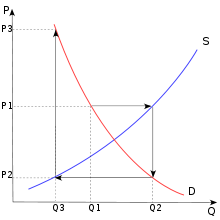
Very simply put: Read more…
Russian volcano activity causes global concern
Now the world has something else to grip about when it comes to Russia – the weather.
A string of volcanoes on Russia’s eastern seaboard of Kamchatka have been unusually active for the last six months. The dust they threw up diverted winds in the Arctic, pushing cold air over Europe and North America and causing the unusually cold winter this year, say scientists.
The volcanoes (160 in total, of which 29 are active) are still on the go and could create more problems this year, depressing harvests around the world just as global food prices soar and Read more…
Magnetic Polar Shifts Causing Massive Global Superstorms
Superstorms can also cause certain societies, cultures or whole countries to collapse. Others may go to war with each other.
 Courtesy: Weather Snob
|
(CHICAGO) – NASA has been warning about it…scientific papers have been written about it…geologists have seen its traces in rock strata and ice core samples…

Now “it” is here: an unstoppable magnetic pole shift that has sped up and is causing life-threatening havoc with the world’s weather.
Forget about global warming—man-made or natural—what drives planetary weather patterns is the climate and what drives the climate is the sun’s magnetosphere and its electromagnetic interaction with a planet’s own magnetic field.
When the field shifts, when it fluctuates, when it goes into flux and begins to become unstable anything can happen. And what normally happens is that all hell breaks loose.
Magnetic polar shifts have occurred many times in Earth’s history. It’s happening again now to every planet in the solar system including Earth.
The magnetic field drives weather to a significant degree and when that field starts migrating superstorms start erupting.
The superstorms have arrived
The first evidence we have that the dangerous superstorm cycle has started is the Read more…
Three of Next Five Winters Could be as Cold or Colder
 This winter is on track to become the coldest for the nation as a whole since the 1980s or possibly even the late 1970s. According to AccuWeather.com Chief Long Range Forecaster Joe Bastardi, three or four out of the next five winters could be just as cold, if not colder.
He is worried that next winter, for example, will be colder than this one.
Bastardi adds that with the U.S. in the middle of one of its worst recessions in its history and the price of oil in question, he is extremely concerned about the prospect for more persistent cold weather in the coming years putting increased financial hardship on Americans.
“Cold is a lot worse than warm,” Bastardi said, “and that’s why your energy bill goes up during the winter time: because of the fact that it takes a lot to heat a house.” Read more…
Why Are Commodity Prices Rising? Let Me Count the Ways
 Our overview of 2011 ‘What Ifs’ concentrated on the concepts of bifurcation and biflation. Those themes are already playing out just a couple of weeks into the New Year. Inflation in all types of commodities has ramped up even further, leaving countries like China, India, Brazil, Thailand and South Korea to deal with more than their fair share of these inflationary forces. Meanwhile, easy monetary policy in the U.S. and Europe just adds fuel to the inflation fire.
The United Nations food agency (FAO) kicked off 2011 by announcing that December of 2010 saw food prices eclipse the record levels hit during the 2008 food crisis, which triggered riots in Egypt, Cameroon, and Haiti at the time. The current spike in food prices has already caused violent food riots in Algeria, Tunisia, Morocco, Yemen, and Jordan.
Food Inflation by the Numbers
Food inflation has already hit double digits in China, India and Brazil. It’s not hard to see why when you look at how some of the major soft commodities have performed over the last 12 months:
- Corn: + 69%
- Wheat: + 47%
- Soy Beans: + 44%
- Sugar: + 15%
- Coffee: + 65%
- Cotton: + 105%
(Trailing 12-month price moves as of January 12, 2011)
While these price spikes are causing food and clothing prices to rise, those effects will undoubtedly be exacerbated by the simultaneous rise in energy and raw materials we have seen:
- Oil: + 15% over 12 months and + 30% since the August, 2010 low
- Copper: + 30%
Overall, you can see the rise in commodity prices in the CRB Index, up about 30% since August of 2010, but well off the parabolic peak of 2008: Read more…


![[Most Recent Quotes from www.kitco.com]](https://i0.wp.com/www.kitconet.com/charts/metals/gold/t24_au_en_usoz_2.gif)
![[Most Recent Quotes from www.kitco.com]](https://i0.wp.com/www.kitconet.com/charts/metals/silver/t24_ag_en_usoz_2.gif)

 crisisboom
 CRISISBOOM
You must be logged in to post a comment.