Archive
Earth’s Dirty Secret: Our Magnetic Field Traps Antimatter
Satellite confirms the existence of antimatter belts surrounding our planet, opens hopes for fuel use
The proton is a familiar figure for those who have taken high school physics. With a +1 charge it is a key constituent to most of the matter of the universe. But nature holds an outlandish vanishing twin — the antiproton. This exotic antimatter particle carries a -1 charge.
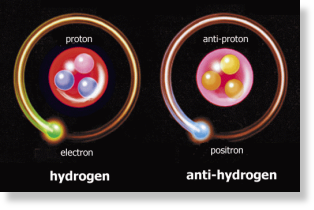
Fifty-six years after their first laboratory observation, a treasure trove of antiprotons — a component of antimatter (right) — has been discovered within the Earth’s magnetic field.
Now astrophysicists have discovered a treasure trove of antimatter hidden in the Earth’s magnetic field, which could hold the key to grand insights and new space travel possibilities.
I. What is Antimatter?
The antiproton was first predicted by luminary physicist Paul Dirac in his 1933 Nobel Prize lecture [PDF]. It would take physicists over two decades to prove Professor Dirac right. In 1955 Emilio Segrè and Owen Chamberlain, research professors at the University of California, Berkley, Read more…
A Strong M-class solar flare headed for Earth
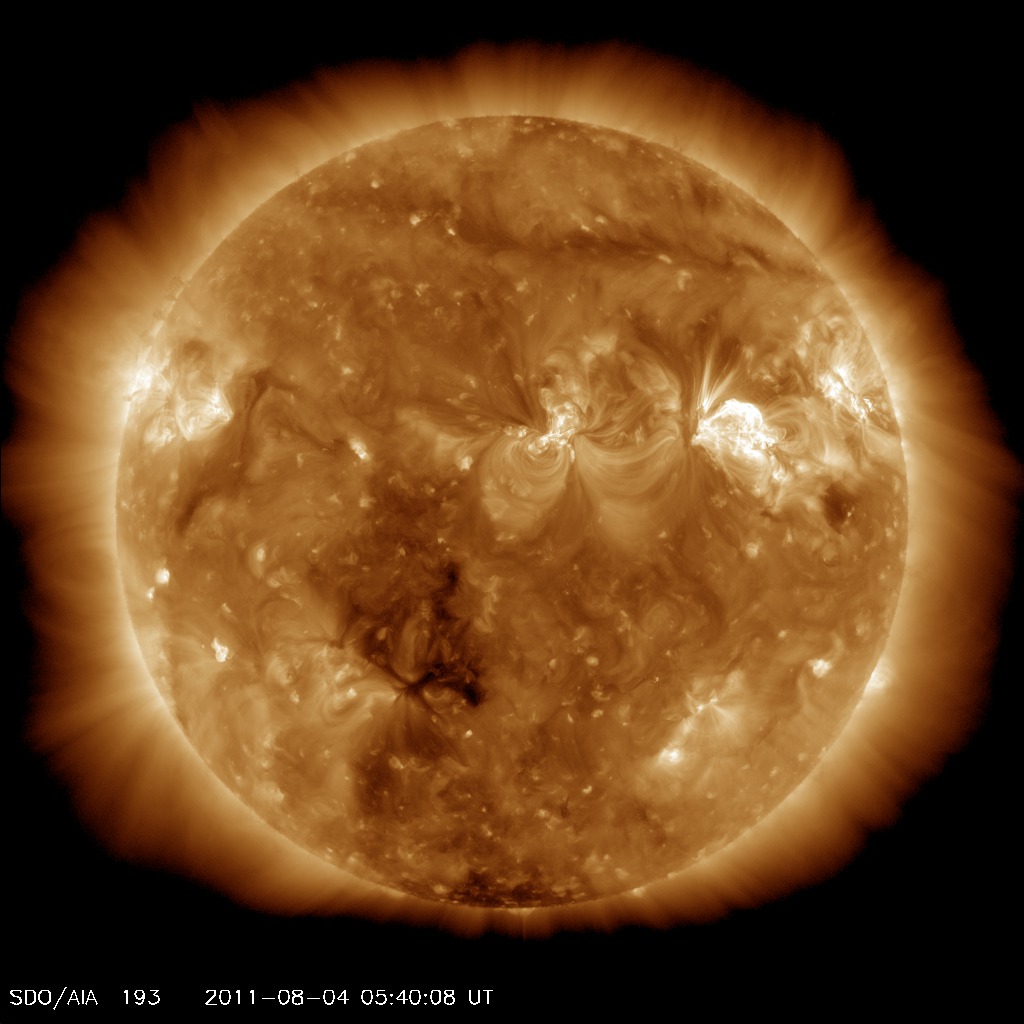
A solar wind stream flowing from the indicated coronal hole should reach Earth on Aug. 7th or 8th. Credit: SDO/AIA.
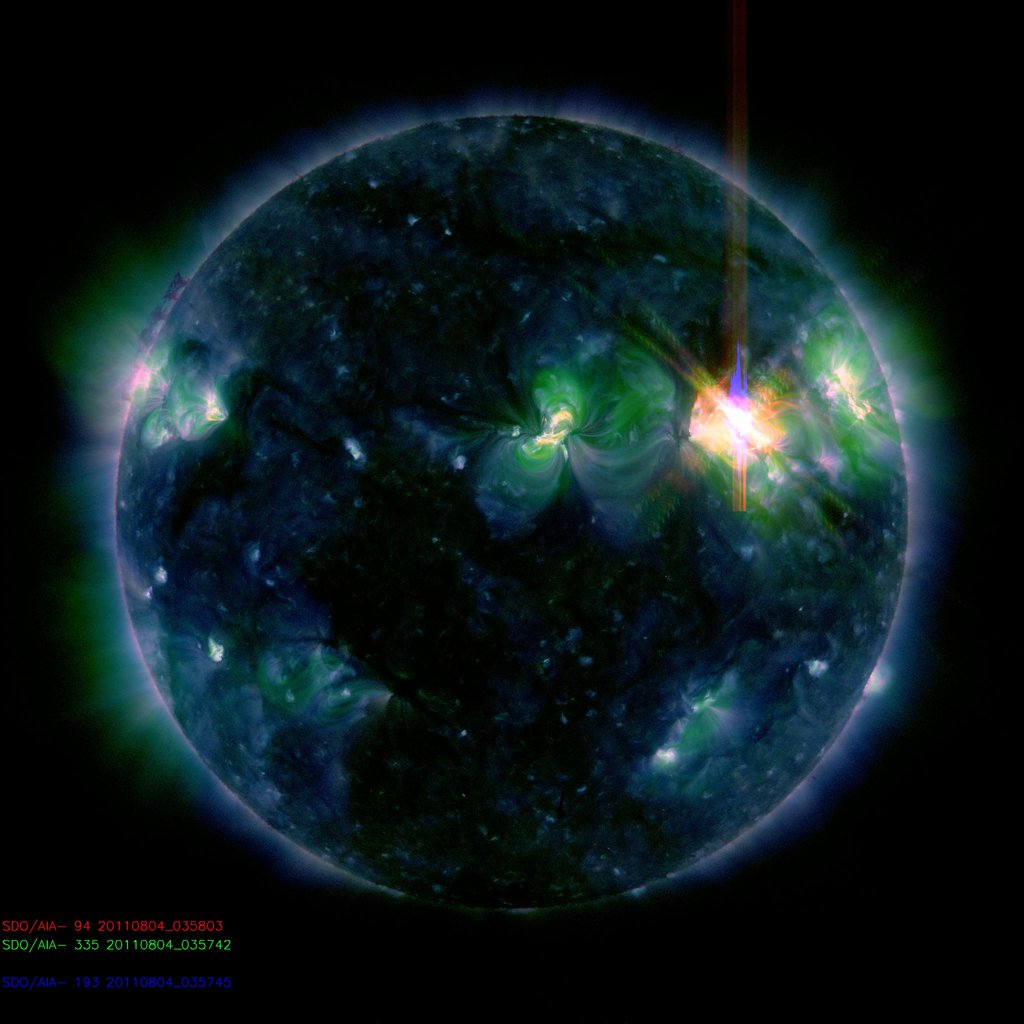
STRONG SOLAR ACTIVITY: For the third day in a row, active sunspot 1261 has unleashed a strong M-class solar flare. The latest blast at 0357 UT on August 4th registered M9.3 on the Richter Scale of Flares, almost crossing the threshold into X-territory (X-flares are the most powerful kind). The number of energetic protons around Earth has jumped nearly 100-fold as a result of this event. Stay tuned for updates.
INCOMING CLOUDS: At least two coronal mass ejections (CMEs) are now en route to Earth, propelled toward us by eruptions in the magnetic canopy of sunspot 1261 on August 2nd and 3rd. Analysts at the GSFC Space Weather Lab have just produced a new 3-D model of the advancing CMEs. Click on the image to set the clouds in motion below:
Why is Time Speeding Up?
 More and more frequently people are suggesting that time is speeding up. We hear people saying things like “I never seem to have enough time to get everything done anymore” or “where has the time gone to”. The years are certainly flying by faster than ever and there is a scientific reason why time is speeding up. There are also a number of reasons why we are changing so rapidly and it is all related to time speeding up. Human beings are becoming more consciously aware and people are being drawn towards spirituality and personal development in greater numbers than ever before. Why is this happening?
Scientists discovered many years ago that the earth gives off a pulse. This pulse or frequency which has been likened to a heartbeat has been stable at Read more…
Reservoirs Can Trigger Earthquakes Say Chinese Geologists Studying Complex Interaction Of Earth And Water
This figure is a presentation of viscous stress and Reynolds stress at multiple micro-spatial scales under ultra-high temperature and pressure conditions.

Credit: ©Science China Press
The extended Coulomb failure stress (ECFS) criteria and anisotropic porosity and permeability tensor at micro/meso/macro scale under ultra‑high temperature and pressure (UTP) conditions were developed employing the flow driven pore‑network crack (FDPNC) model under multiple temporal–spatial scales and the hybrid hypersingular integral equation‑lattice Boltzmann method (HHIE‑LBM). The correlation of the Zipingpu reservoir and Longmenshan slip was then analyzed and the fluid–solid coupled three‑dimensional facture mechanism of the reservoir and earthquake fault was explored.
Describing the correlation of a reservoir and Read more…
Behemoth sunspots evolve
The SDO team has just prepared a beautiful movie of the explosion that produced the CME.
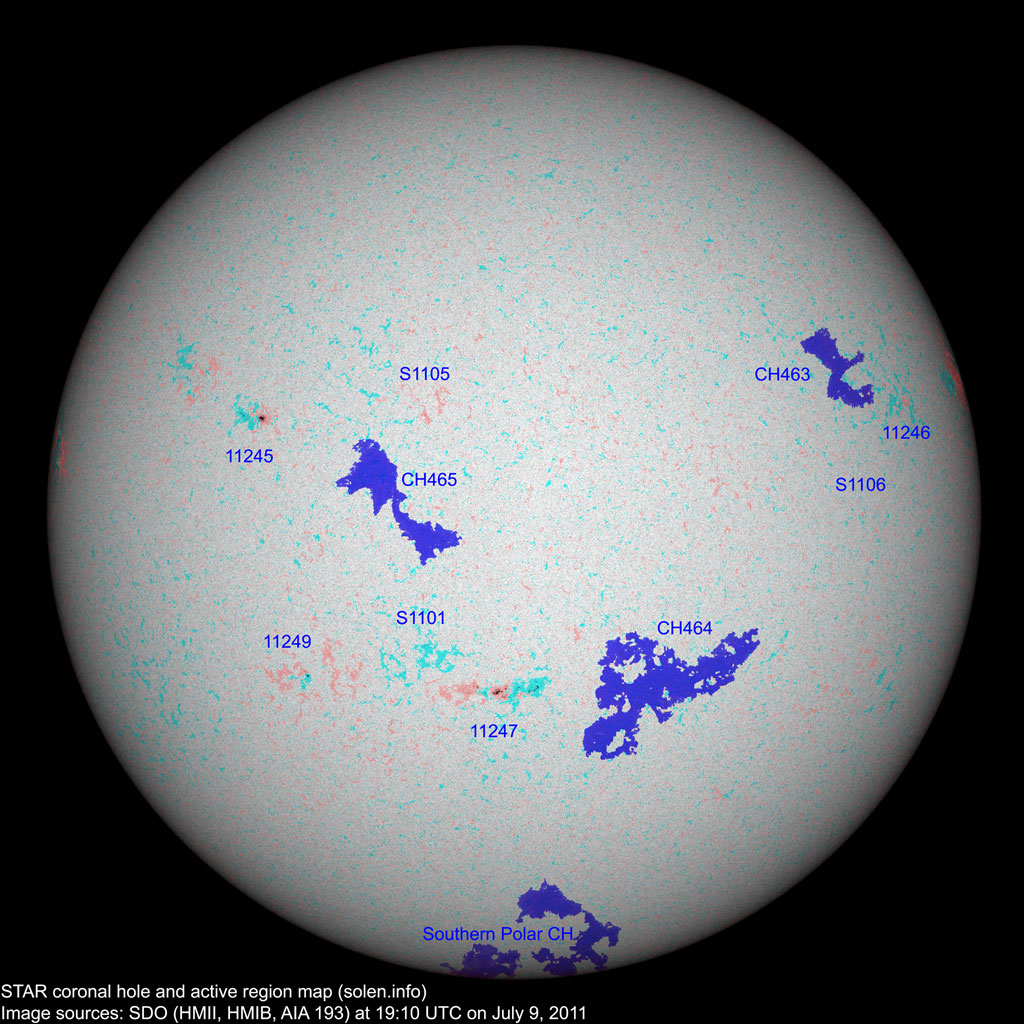
Sunspot group 1247 is expanding rapidly and in an interesting way. The active region is organizing itself as a linear Read more…
New industrial revolution needed to avert ‘planetary catastrophe’ – UN report

2010 – 2011: Earth’s most extreme weather since 1816?
 Every year extraordinary weather events rock the Earth. Records that have stood centuries are broken. Great floods, droughts, and storms affect millions of people, and truly exceptional weather events unprecedented in human history may occur. But the wild roller-coaster ride of incredible weather events during 2010, in my mind, makes that year the planet’s most extraordinary year for extreme weather since reliable global upper-air data began in the late 1940s. Never in my 30 years as a meteorologist have I witnessed a year like 2010–the astonishing number of weather disasters and unprecedented wild swings in Earth’s atmospheric circulation were like nothing I’ve seen. The pace of incredible extreme weather events in the U.S. over the past few months have kept me so busy that I’ve been unable to write-up a retrospective look at the weather events of 2010. But I’ve finally managed to finish, so fasten Read more…
Study finds global warming over past 400 years was due to increased Solar activity

Apparently previous studies of the sun-climate connection looked at the equatorial polar magnetic field which produces sun spots, but they did not consider the polar magnetic component of the solar dynamo. The polar fields are less strong than the equatorial fields, but it is claimed that the total magnetic fluxes of both fields are comparable. With proxy data they derive an empirical relation between tropospherical temperatures and solar equatorial and polar magnetic fields. The polar field could contribute about Read more…
Record Heat stories US and the world
 Record temperature at 51 degrees Celsius in Kuwait — Ramadan
Outages extend into third day for residents, offices
Record Heat Closes Baltimore County Schools Early
Record High Temperatures Expected For The Remainder Of This Week-Rome
Bluefield, ‘Nature’s Air-Conditioned City’, breaks heat record with 90 degrees
Britain prepares for a heatwave…as Ireland gets its woollies on
Barbecue Britain? It’s been the warmest spring since records began in 1659…
Heatwave claims three more lives in Lahore
Electric usage surges during record heat
Colorado weather forecast: Near-record heat expected Thursday
Time to shift view of seismic risk – experts
 |
Knowledge of seismic risk is badly skewed in favour of earthquakes that occur on plate boundaries, such as the March 11 temblor that hit northeast Japan, rather than those that strike deep inland, a pair of scientists said on Sunday.
In commentary appearing in the journal Nature Geoscience, Philip England of Oxford University and James Jackson of Cambridge University say that in seismic terms, the 9.0-magnitude Sendai quake was “a remarkable story of resilience.”
Good civic training and building construction meant that the death rate was “impressively low,” they said. Around 25,000 people died, or 0.4 percent of those exposed to the event, and most of these died from the tsunami that followed.
The March 11 event occurred on a plate boundary, where the jigsaw of plates that float on Earth’s crust jostle and grind and slide under each other.
England and Jackson say plate boundaries are relatively well-studied, but a far greater threat lurks in continental inland areas.
“Death rates in earthquakes within continental interiors have often exceeded five percent and can be as high as 30 percent,” they warn.
According to their count, over the past 120 years, there have been around Read more…


![[Most Recent Quotes from www.kitco.com]](https://i0.wp.com/www.kitconet.com/charts/metals/gold/t24_au_en_usoz_2.gif)
![[Most Recent Quotes from www.kitco.com]](https://i0.wp.com/www.kitconet.com/charts/metals/silver/t24_ag_en_usoz_2.gif)

 crisisboom
 CRISISBOOM
You must be logged in to post a comment.