Archive
NASA Eyes Dominican Republic Lake’s Mysterious Growth
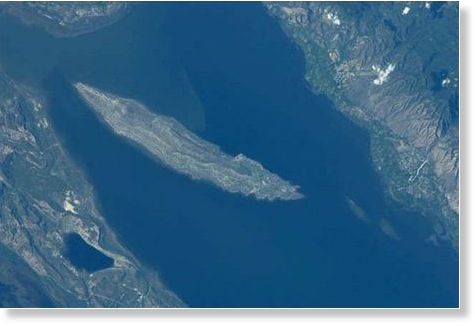
Enriquillo, Cabrito island within. Photo nasa.gov.
Santo Domingo.- Enriquillo Lake has grown around 9,000 hectares from February 26, 2009, to April 15, 2011, a NASA sensor measurement reveals from space, while the Santo Domingo State University’s (UASD) Marine Research Center suggests that two underground currents at the Haiti-Dominican border as the possible cause.
The UASD hypothesis that the subsurface currents from Tierra Nueva and Las Lajas, towns adjacent to Haitian territory, spill their waters into Enriquillo and Azuey lakes, could turn out to be the cause behind the as yet unexplained flooding in both bodies of water.
“That amount of water is still draining towards Enriquillo lake from high territories” in the Dominican Republic, NASA said on its Website, and affirms that the lake’s surroundings “have been flooded even more than the floods brought about by the rain sequel caused by Hurricane Noel and Tropical Storm Olga in 2007.”
NASA’s measurements of Enriquillo’s underflow level were done with Landsat and Modis type sensors, which also provided satellite imagery in the study.
Enriquillo received 400 millimeters of water during those rains, and surpass 700 millimeters in the last two years, without any rain in the zone, which reveals the magnitude of the flooding that affects the Caribbean region’s biggest lake since 2009.
Study: Volcanoes can trigger bigger climate impact

Volcanic eruptions might affect earth’s climate by releasing far more weather-altering particles than scientists have suspected previously, a new study has found.
A team of researchers, who wanted to find out the influence of volcanoes on global climate, investigated the huge eruption of the Eyjafjallajokull volcano in Iceland on March 20, 2010.
From a research station in France, they monitored the volcano’s eruption, which rapidly ejected large ash particles into the atmosphere and spread all over Europe. They then analysed how many secondary particles this ash generated upon reacting chemically with Read more…
New Force Driving Earth’s Tectonic Plates: ‘Hot Spots’ Of Plume From Deep Earth Could Propel Plate Motions Around Globe Discover Scripps Researchers
Bringing fresh insight into long-standing debates about how powerful geological forces shape the planet, from earthquake ruptures to mountain formations, scientists at Scripps Institution of Oceanography at UC San Diego have identified a new mechanism driving Earth’s massive tectonic plates.
Reconstruction of the Indo-Atlantic Ocean 63 million years ago, during the time of the superfast motion of India which Scripps scientists attribute to the force of the Reunion plume head. The arrows show the relative convergence rate of Africa (black arrows) and India (dark blue) relative to Eurasia before, during and after (from left to right) the period of maximum plume head force. The jagged red and brown lines northeast of India show two possible positions of the trench (the subduction zone) between India and Eurasia depending on whether the India-Eurasia collision occurred 52 million years ago or 43 million years ago.

Credit: Scripps Institution of Oceanography
Scientists who study tectonic motions have known for decades that the ongoing “pull” and “push” movements of the plates are responsible for sculpting continental features around the planet. Volcanoes, for example, are generally located at areas where plates are moving apart or coming together. Scripps scientists Steve Cande and Dave Stegman have now discovered a new force that drives plate tectonics: Plumes of hot magma pushing up from Earth’s deep interior. Their research is published in the July 7 issue of the journal Nature.
Using analytical methods to track plate motions through Earth’s history, Cande and Stegman’s research provides Read more…
North Carolina Most At-Risk Against Rising Sea Levels
 If one man could hold back the sea, North Carolina wouldn’t need to worry about rising ocean levels. Neither would New York, Boston or Miami. (Photo: Reuters Photographer/Reuters)
The problem with reports about rising sea levels is that the damn thing—the world’s ocean—seems to creep up very, very slowly. In the past 21 centuries it’s raised an average of .07874 an inch every year, about the thickness of a nickel.
That doesn’t sound like much, right? Nothing to worry about! But what makes rising sea levels a deadly serious problem is that the ocean just keeps creeping up, up, up. And the average in recent decades is more like an inch a year.
In fact a new report from the National Academy of Sciences says the rate of Read more…
Collapsing Coastlines


Storms can ravage coastal permafrost, as shown near the village of Kaktovik, Alaska.© Accent Alaska.com/Alamy
Gray waves surged over miles and miles of open water, breaking against the bluffs underlying Kaktovik. The tiny village sits precariously on the Beaufort Sea, a frigid body of water bordering Alaska’s northeastern Arctic coast. As the choppy waters inundated vulnerable stretches of shoreline, the surf carved deep chasms into the tall bluffs.
Torre Jorgenson, a geomorphologist working near Kaktovik, watched the storm boil up, shaking homes and boats for nearly two days in July 2008. Dramatic erosion followed soon after. Blocks of graphite-colored earth, as much as 10 meters wide and several meters deep, toppled into the sea one by one like skyscrapers in a Japanese monster film.
“The locals had never seen that type of erosion,” says Jorgenson, also president of the U.S. Permafrost Association. “It was something new, a regime change.”
The erosion Jorgenson witnessed was a potent warning to Kaktovik’s residents of the instability of their coastal home. Seaside bluffs and beaches across the Arctic are Read more…
Experts warn epic weather ravaging US could worsen

CHICAGO — Epic floods, massive wildfires, drought and the deadliest tornado season in 60 years are ravaging the United States, with scientists warning that climate change will bring even more extreme weather.
The human and economic toll over just the past few months has been staggering: hundreds of people have died, and thousands of homes and millions of acres have been lost at a cost estimated at more than $20 billion.
And the United States has not even entered peak hurricane season.
“This spring was one of the most extreme springs that we’ve seen in the last century since we’ve had good records,” said Deke Arndt, chief of climate monitoring for the National Oceanic and Atmospheric Administration (NOAA).
While it’s not possible to tie a specific weather event or pattern to climate change, Arndt said this spring’s extreme weather is in line with what is forecast for the future.
“In general, but not everywhere, it is expected that the wetter places will get wetter and the drier places will tend to see more prolonged dry periods,” he told AFP.
“We are seeing an increase in the amount (of rain and snow) that comes at once, and the ramifications are that it’s a lot more water to deal with at a Read more…
World’s Oceans In ‘Shocking’ Decline
 The oceans are in a worse state than previously suspected, according to an expert panel of scientists.
In a new report, they warn that ocean life is “at high risk of entering a phase of extinction of marine species unprecedented in human history”.
They conclude that issues such as over-fishing, pollution and climate change are acting together in ways that have not previously been recognised.
The impacts, they say, are already affecting humanity.
The panel was convened by the International Programme on the State of the Ocean (IPSO), and brought together experts from different disciplines, including coral reef ecologists, toxicologists, and fisheries scientists.
Its report will be formally released later this week.
“The findings are shocking,” said Alex Rogers, IPSO’s scientific director and professor of conservation biology at Oxford University.
“As we considered the cumulative effect of what humankind does to the oceans, the implications became far worse than we had individually realised.
“We’ve sat in one forum and spoken to Read more…
Study finds global warming over past 400 years was due to increased Solar activity

Apparently previous studies of the sun-climate connection looked at the equatorial polar magnetic field which produces sun spots, but they did not consider the polar magnetic component of the solar dynamo. The polar fields are less strong than the equatorial fields, but it is claimed that the total magnetic fluxes of both fields are comparable. With proxy data they derive an empirical relation between tropospherical temperatures and solar equatorial and polar magnetic fields. The polar field could contribute about Read more…
Scientists are sounding the alarm: the mysterious cracks appear across the planet
 Scientists do not know what to think about: South America is bursting at the seams. In southern Peru, suddenly appeared a huge crack length of 3 km and a width of about 100 meters.
Anomaly occurred in the district Huakullani Chukuito province near the famous Lake Titicaca. A crack has appeared almost immediately: the earth like a burst at the site of a large tension, the far scattered huge chunks of soil.
Interestingly, the crack did not appear in the earthquake. In general, there was no catastrophe, the earth simply gone. The crack occurred on level ground and is not associated with any disasters. Scientists are confused with this fact. Cracks also appear in neighboring Bolivia. And not so long ago, the crack happened in Africa – Ethiopia. Maybe these phenomena is common nature: the continents literally split in front of mankind. (BetaNovosti)
Recommended readings: Read more…
North America, southern Europe and China all likely to undergo extreme temperature shifts within 60 years
Tropical regions in Africa, Asia and South America could see ‘the permanent emergence of unprecedented summer heat’ in the next 20 years, scientists have warned.
The tropics and much of the  Northern Hemisphere are likely to experience an irreversible rise in summer temperatures if greenhouse gas emissions continue at their present rate, a study claims.
Researchers at Stanford University said North America – including the U.S. – southern Europe and China are likely to undergo extreme summer temperature shifts within 60 years.
Red dunes in Namibia. Much of Africa, Asia and South America could see ‘the permanent emergence of unprecedented summer heat’ in the next 20 years
This dramatic change could have severe consequences for human health, agricultural production and Read more…


![[Most Recent Quotes from www.kitco.com]](https://i0.wp.com/www.kitconet.com/charts/metals/gold/t24_au_en_usoz_2.gif)
![[Most Recent Quotes from www.kitco.com]](https://i0.wp.com/www.kitconet.com/charts/metals/silver/t24_ag_en_usoz_2.gif)

 crisisboom
 CRISISBOOM

You must be logged in to post a comment.