Archive
Atmosphere Above Japan Heated Rapidly Before M9 Earthquake
Infrared emissions above the epicenter increased dramatically in the days before the devastating earthquake in Japan, say scientists.

Technology Review
Published by MIT
Geologists have long puzzled over anecdotal reports of strange atmospheric phenomena in the days before big earthquakes. But good data to back up these stories has been hard to come by.
In recent years, however, various teams have set up atmospheric monitoring stations in earthquake zones and a number of satellites are capable of sending back data about the state of the upper atmosphere and the ionosphere during an earthquake.
Last year, we looked at some fascinating data from the DEMETER spacecraft showing a significant increase in ultra-low frequency radio signals Read more…
Warm Water Causing Cold Winters
 This map shows sea‑surface temperatures averaged over eight days in September 2001, as measured by NASA’s Terra satellite. Dark red represents warm water (32 degrees Celsius) and purple is cold (‑2 degrees Celsius). The Gulf Stream can be seen as the orange strip extending from the eastern U.S. toward the Atlantic.
Imagine this: you are standing outside in New York City while waiting for a cab. It is in the winter and you are likely freezing. What if you were doing the same thing, but in Porto, Portugal?
Porto shares the same latitude at the Big Apple, but in Portugal you would be about 10 degrees warmer.
This happens for the northeastern coast of the U.S. and eastern coast of Canada. This is also true in other parts of the world. When the northeastern coast of Asia is colder, the Pacific Northwest is warmer.
Researchers at the California Institute of Technology have found an explanation. The culprit is warmer water off the eastern coasts of Read more…
Ozone hole linked to southern rain increases
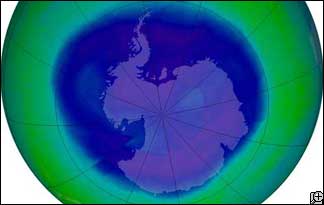 WASHINGTON — The hole in the ozone layer over Antarctica is a significant driver of climate change and rain increases in the southern hemisphere over the past 50 years, US scientists said Thursday.
The findings by a team at Columbia University’s School of Engineering and Applied Science are the first to link ozone depletion in the polar region to climate change all the way to the equator.
Researchers said the analysis should lead policy-makers to consider the ozone layer along with other environmental factors such as Arctic ice melt and greenhouse gas emissions when considering how to tackle climate change.
“It’s really amazing that the ozone hole, located so high up in the atmosphere over Antarctica, can have an impact all the way to the tropics and affect rainfall there,” said Sarah Kang, lead author of the study in the journal Science. Read more…
NAM 12: Scientists see solar outburst in exquisite detail
The largest disturbances to the Earth’s geomagnetic environment occur when it is buffeted by solar material hurled in our direction by explosive changes in the Sun’s atmosphere. These Coronal Mass Ejections or CMEs contain approximately a billion tonnes of ionized gas or plasma and can have a dramatic and damaging impact on everything from satellites to power grids.

Now a team of scientists have used two spacecraft to study these events in unprecedented detail. Graduate student Anthony Williams of the University of Leicester will present their results on Tuesday 19 April at the Royal Astronomical Society’s National Astronomy Meeting in Llandudno, Wales.
Mr Williams and his team used the Heliospheric Imagers (HI) on the Solar TErrestrial RElations Observatory (STEREO) spacecraft to examine the internal structure of an Earth-impacting CME – seen as sunlight scattered from high density blobs of plasma – as it travels outwards from the Sun. They compared this with the internal structure measured in situ by the Read more…
China-Russia relations and the United States: At a turning point?
 By Dr. Richard Weitz
Since the end of the Cold War, the improved political and economic relationship between Beijing and Moscow has affected a range of international security issues. China and Russia have expanded their bilateral economic and security cooperation. In addition, they have pursued distinct, yet parallel, policies regarding many global and regional issues.
Yet, Chinese and Russian approaches to a range of significant subjects are still largely uncoordinated and at times in conflict. Economic exchanges between China and Russia remain minimal compared to those found between most friendly countries, let alone allies.
Although stronger Chinese-Russian ties could present greater challenges to other countries (e.g., the establishment of a Moscow-Beijing condominium over Central Asia), several factors make it unlikely that the two countries will form such a bloc.
The relationship between the Chinese and Russian governments is perhaps the best it has ever been. The leaders of both countries engage in numerous high-level exchanges, make many mutually supportive statements, and manifest other displays of Russian-Chinese cooperation in what both governments refer to as their developing strategic partnership.
The current benign situation is due less to common values and shared interests than to the fact that Chinese and Russian security concerns are Read more…
Giant ocean whirlpools puzzle scientists
 US scientists discovered two giant whirlpools in the Atlantic Ocean, off the coast of Guyana and Suriname. It became a sensational discovery because this part of the ocean has been studied thoroughly, and no one expected anything like that to appear in the area. More importantly, no one can understand where the whirlpools came from and what surprises they may bring to people.
According to Brazilian scientist Guilherme Castellane, the two funnels are approximately 400 kilometers in diameter. Until now, these were not known on Earth. The funnels reportedly exert a strong influence on climate changes that have been registered during the recent years.
“Funnels rotate clockwise. They are moving in the ocean like giant frisbees, two discs thrown into the air. Rotation occurs at a rate of one meter per second, the speed is Read more…
Ozone layer damaged by unusually harsh winter

An image of total ozone column profile around the North Pole on March 30, 2011, developed by the Finnish Meteorological Institute using satellite and ground-based data, is seen in this handout, April 5, 2011. Satellite measurement of total ozone from OMI (Ozone Monitoring Instrument) shows a region of low ozone (blue region) above the Arctic regions. As of late March the ozone-poor region is shifted away from the pole and covers Greenland and Scandinavia. — WMO via Reuters
The stratospheric ozone layer, which shields the Earth from the Sun’s harmful ultraviolet rays, has been damaged to its greatest-ever extent over the Arctic this winter.
The protective layer of gas, which can be destroyed by reactions with industrial chemicals, has suffered a loss of about 40 per cent from the start of winter until late March, exceeding the previous seasonal loss of about 30 per cent, according to the World Meteorological Organisation (WMO).
The phenomenon is annual in the Antarctic, where after its discovery in the 1980s it came to be known as the “ozone hole“. Although CFC levels are now dropping, they remain in the atmosphere for so long that they will still be causing ozone depletion for decades in certain conditions, particularly the intense cold of the stratosphere.
Arctic ozone conditions vary more and the temperatures are always warmer than over Antarctica, where the ozone hole forms high in the stratosphere near the South Pole each winter and spring. Because of changing weather and temperatures, some Arctic winters experience almost no ozone loss – but others with exceptionally cold stratospheric conditions can occasionally lead to substantial ozone depletion.
This is what has happened over the Arctic this winter; for while at ground level the Arctic region was unusually warm, temperatures 15-20km above the Earth’s surface plummeted. WMO officials say the latest losses, which are unprecedented, were detected in Read more…
Wind and waves growing across globe: study

Photo by Todd Binger
(PhysOrg.com) — Oceanic wind speeds and wave heights have increased significantly over the last quarter of a century according to a major new study undertaken by ANU Vice-Chancellor Professor Ian Young.
First North Pole Ozone Hole Forming?

Spawned by strangely cold temperatures, “beautiful” clouds helped strip the Arctic atmosphere of most of its protective ozone this winter, new research shows.
The resulting zone of low-ozone air could drift as far south as New York, according to experts who warn of increased skin-cancer risk.
The stratosphere’s global blanket of ozone—about 12 miles (20 kilometers) above Earth—blocks most of the sun‘s high-frequency ultraviolet (UV) rays from hitting Earth’s surface, largely preventing sunburn and skin cancer.
But a continuing high-altitude freeze over the Arctic may have already reduced ozone to half its normal concentrations—and “an end is not in sight,” said research leader Markus Rex, a physicist for the Alfred Wegener Institute for Polar and Marine Research in Bremerhaven, Germany.
Preliminary data from 30 ozone-monitoring stations throughout the Arctic show the Read more…
Earth’s Core Provides Climate Insights

Summary: By studying the molten core of the planet Earth, scientists have uncovered new evidence that humans play a dominant role in changing Earth's climate. The study could have important implicaitons in understanding the future of life on our planet.
The latest evidence of the dominant role humans play in changing Earth’s climate comes not from observations of Earth’s ocean, atmosphere or land surface, but from deep within its molten core.
Scientists have long known that the length of an Earth day – the time it takes for Earth to make one full rotation – fluctuates around a 24-hour average. Over the course of a year, the length of a day varies by about 1 millisecond, getting longer in the winter and shorter in the summer. These seasonal changes in Earth’s length of day are driven by exchanges of energy between the solid Earth and fluid motions of Earth’s atmosphere (blowing winds and changes in atmospheric pressure) and its ocean. Scientists can measure these small changes in Earth’s rotation using astronomical observations and very precise geodetic techniques.
But the length of an Earth day also fluctuates over much longer timescales, such as interannual (two to 10 years), decadal (approximately 10 years), or those lasting multiple decades or even longer. A dominant longer timescale mode that ranges from 65 to 80 years was observed to change the length of day by approximately 4 milliseconds at the beginning of the Read more…


![[Most Recent Quotes from www.kitco.com]](https://i0.wp.com/www.kitconet.com/charts/metals/gold/t24_au_en_usoz_2.gif)
![[Most Recent Quotes from www.kitco.com]](https://i0.wp.com/www.kitconet.com/charts/metals/silver/t24_ag_en_usoz_2.gif)

 crisisboom
 CRISISBOOM
You must be logged in to post a comment.