Archive
Walking on thin ice
 Antarctica
Icebergs break away as the melting Antarctica landscape yields to glabal warming. Photo: Angela Wylie
Every now and then the magnificent, mute marble coast of Antarctica will suddenly find a voice and let out a shattering exclamation – like a gunshot. The noise travels far and wide, thundering uninterrupted across crystal space until sheer distance exhausts it.
It is the sound of an ice cliff collapsing into the ocean. Or maybe of a new iceberg cleaving itself away from the continent and setting sail. It is part of the natural soundtrack of planet history, though it is only rarely, and recently – in geological timescales – heard by humans.
In little remote scientific communities like the Australian Antarctic Division’s Casey Station, on the East Antarctic coast, a roar from the ice might briefly interrupt the labour or conversation of the scientists and tradesfolk who are resident there, working on some aspect of deciphering the climate story. For those lucky enough to be among them, to hear it, it sends a shiver of humility through your bones. You are, after all, at the mercy of this grumbling giant. The cryosphere Read more…
New report confirms Arctic melt accelerating

FILE - In this July 19, 2007 file photo an iceberg is seen off Ammassalik Island in Eastern Greenland. A new assessment of climate change in the Arctic shows the ice in the region is melting faster than previously thought and sharply raises projections of global sea level rise this century. (AP Photo/John McConnico, File)
STOCKHOLM (AP) — Arctic ice is melting faster than expected and could raise the average global sea level by as much as five feet this century, an authoritative new report suggests.
The study by the international Arctic Monitoring and Assessment Program, or AMAP, is one of the most comprehensive updates on climate change in the Arctic, and builds on a similar assessment in 2005.
The full report will be delivered to foreign ministers of the eight Arctic nations next week, but an executive summary including the key findings was obtained by The Associated Press on Tuesday.
It says that Arctic temperatures in the past six years were the highest since measurements began in 1880, and that feedback mechanisms believed to accelerate warming in the climate system have now started kicking in.
One mechanism involves the ocean absorbing more heat when it’s not covered by ice, which reflects the sun’s energy. That effect has been anticipated by scientists “but clear evidence for it has only been observed in the Arctic in the past five years,” AMAP said.
The report also shatters some of the forecasts made in 2007 by the U.N.’s expert panel on climate change.
The cover of sea ice on the Arctic Ocean, for example, is shrinking faster than Read more…
Sea level rises the fastest in 350 years

MELTING mountain glaciers are contributing to the fastest sea level rise in 350 years, according to research by Welsh scientists.
The team from Aberystwyth University, the University of Exeter and Stockholm University undertook a survey of the 270 largest outlet glaciers of the south and north Patagonian icefields of South America.
They mapped changes in the position of the glaciers since the Little Ice Age, which was the last time in the recent past when they were much larger.
The team calculated the volume of ice lost by the glaciers as they have retreated and thinned over the past 350 years and compared these volume losses to rates of change over the last 30 years.
They found that the rate at which the glaciers are losing volume over the past 30 years is between 10 and 100 times faster than the 350- year long-term average.
The study, which has been published in the journal Nature Geoscience, concludes the mountain glaciers have rapidly increased their melt rate in recent years and consequently their contribution to global sea level.
Lead author, Professor Neil Glasser of Aberystwyth University, said the work was based on a longer timescale than any earlier glacier research conducted.
The second author Dr Stephan Harrison of the University of Exeter, said: “The work is significant because it is the first time anyone has made a direct estimate of the sea-level contribution from glaciers since the peak of the Industrial Revolution.”
Large-Scale Assessment Of The Arctic Ocean: Significant Increase In Freshwater Content Since 1990s
The freshwater content of the upper Arctic Ocean has increased by about 20 percent since the 1990s. This corresponds to a rise of approx. 8,400 cubic kilometres and has the same magnitude as the volume of freshwater annually exported on average from this marine region in liquid or frozen form. This result is published by researchers of the Alfred Wegener Institute in the journal Deep-Sea Research. The freshwater content in the layer of the Arctic Ocean near the surface controls whether heat from the ocean is emitted into the atmosphere or to ice. In addition, it has an impact on global ocean circulation.
Differences in the mean salinity of the Arctic Ocean above the 34 isohaline between 2006 to 2008 and 1992 to 1999.

Negative values are shown in yellow, green, and blue and stand for an increase of freshwater.
Image: Benjamin Rabe, Alfred Wegener Institute Read more…
Breaking: Newly Obtained Homeland Security Documents Reveal Radical Shift In Internet Policy
FIGHT BACK: Internet user arrested for linking to other websites.
 Brian McCarthy ran a website, channelsurfing.net, that linked to various sites where you could watch online streams of TV shows and sports networks. A couple months ago, the government seized his domain name and on Friday they arrested him and charged him with criminal copyright infringement — punishable by five years in prison.
We just obtained a copy of the complaint (below) that the Department of Homeland Security (DHS) and Immigrations and Customs Enforcement (ICE) made against him — and they don’t even allege that he made a copy of anything! Just that he ran what they call a “linking website” which linked to various sites with copyrighted material. Under that sort of thinking, everyone who’s sent around a link to a copyrighted YouTube video is a criminal.
This is another shocking overreach by DHS and ICE — a steamship-era department that’s proving once again that it doesn’t understand the Internet. We need to push back — and fast — before they try to lock up more Americans.
PETITION TO JANET NAPOLITANO, DIRECTOR OF HOMELAND SECURITY, AND JOHN MORTON, DIRECTOR OF IMMIGRATION AND CUSTOMS ENFORCEMENT: There’s nothing wrong or illegal about posting a link to a website. This is another shocking overreach by ICE: You need to drop the charges against Brian McCarthy right away.
Global warming means more snowstorms: scientists
Climate change is not only making the planet warmer, it is also making snowstorms stronger and more frequent, US scientists said on Tuesday.
 Workers remove snow from a runway at O’Hare International Airport on February 3, in Chicago, Illinois. Climate change is not only making the planet warmer, it is also making snowstorms stronger and more frequent, US scientists said on Tuesday.
“Heavy snowstorms are not inconsistent with a warming planet,” said scientist Jeff Masters, as part of a conference call with reporters and colleagues convened by the Union of Concern Scientists.
“In fact, as the Earth gets warmer and more moisture gets absorbed into the atmosphere, we are steadily loading the dice in favor of more extreme storms in all seasons, capable of causing greater impacts on society.”
Masters said that the northeastern United States has been coated in heavy snowfall from Read more…
Flooding Risk Raised for Midwest, Northeast, Neighboring Canada
Concerns for flooding continue through next week as two storms roll through the Midwest and the Northeast and adjoining areas of southern Canada.
First Storm
The storm coming today into Friday traveling from the Midwest to the Northeast U.S. will be the colder of the two storms.
What this means is that snow or a wintry mix will fall from around the central and lower Great Lakes through the northern mid-Atlantic and into New England. Rain will fall over the Ohio Valley through most of the balance of the mid-Atlantic and into southeastern New England and Nova Scotia.
Up north and well inland of the coast the snow and wintry mix will add to the water equivalent of the existing snowpack or will reduce that snowpack by very little.
According to Chief Meteorologist Elliot Abrams, “Farther south and along the coast, heavy rain or the combination of rain and melting snow and ice will lead to urban flooding problems and perhaps some rises on streams and rivers.”
With the ground still frozen in some areas, the water will run off crossing roads, collect in fields, backyards and city streets.
According to Senior Meteorologist and Indiana native Jim Andrews, “In the Ohio and Tennessee valleys into Friday, enough rain can fall without the aid of melting snow to lead to rises on rivers and small stream flooding.” Read more…
Antarctica Mysteries
 For any who wish to track behind me, the above 1st image is included here to help locate the evidence site on the coastal area of Antarctica at the Southern Sea but inland from the coast. When zooming in on this site in Google Earth, one will encounter a narrow pale blue strip at this location within which the evidence reported on here resides. That pale blue strip is a corridor of high resolution surrounded by an extensive sea of smudge obfuscation and that narrow higher resolution strip is the sole reason why we are able to view just a little truth here. Read more…
Map shows most of Northern Hemisphere is covered in snow and ice
At first glance it looks like a graphic from a Discovery Channel program about a distant ice age. But this astonishing picture shows the world as it is today – with half the Northern Hemisphere covered with snow and ice.
The image was released by the National Oceanic And Atmospheric Association (NOAA) on the day half of North America was in the grip of a severe winter storm.
The map was created using multiple satellites from government agencies and the US Air Force.
That Antarctica, the Arctic, Greenland and the frozen wastes of Siberia are covered in white comes as no surprise. But it is the extent to which the line dips down over the Northern Hemisphere that is so remarkable about the image.
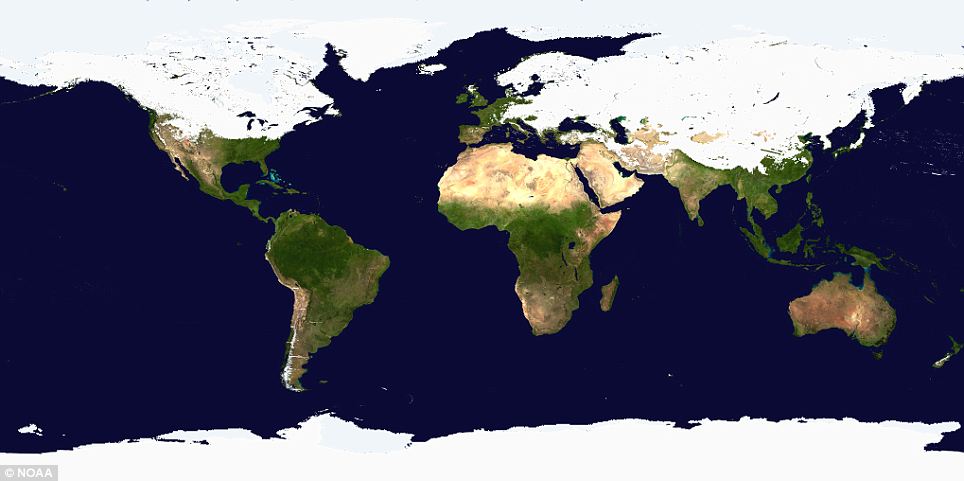
The shroud of white stretches down from Alaska and sweeps through the Midwest and along to the Eastern seaboard. The bitter cold has reached as far as Texas and northern Mexico where in Ciudad Juarez temperatures today were expected to dip to minus 15C.
In the U.S. tens of millions of people chose to stay at home rather than venture out. In Chicago, 20in of snow fell leading to authorities closing schools for the first time in 12 years. The newspaper for Tulsa, Okalahoma, was unable to publish its print edition for the first time in Read more…
Arctic Sea-Ice Controls the Release of Mercury
Mercury is the most high profile atmospheric contaminant entering the Arctic because it is a potent neurotoxin that biomagnifies in food webs. In the troposphere (lower atmosphere) it is primarily present in the form of gaseous elemental mercury.  Photochemical reactions during the Arctic spring (Figure 1) combine salts from sea ice and the gaseous mercury in the air to create an oxidized reactive form of mercury. This mercury is then deposited to snow and ice. These deposition events require salty sea ice and snow crystal surfaces so they are widespread in the Polar Regions.
Mercury (Hg) is the only heavy metal that is essentially found in gaseous form in the atmosphere. Since the industrial revolution, emissions of anthropogenic Hg resulting from the combustion of fossil fuels have exceeded natural emissions. Both anthropogenic emissions and natural emissions (which mainly stem from the oceans and gases released by volcanoes) reach the Polar Regions under the action of atmospheric currents. In this way, fallout from global atmospheric pollution contributes to depositing mercury in Arctic ecosystems, even though these are far away from major anthropogenic emission sources. Read more…


![[Most Recent Quotes from www.kitco.com]](https://i0.wp.com/www.kitconet.com/charts/metals/gold/t24_au_en_usoz_2.gif)
![[Most Recent Quotes from www.kitco.com]](https://i0.wp.com/www.kitconet.com/charts/metals/silver/t24_ag_en_usoz_2.gif)

 crisisboom
 CRISISBOOM
You must be logged in to post a comment.