Archive
Scientists Project Path of Radiation Plume
A United Nations forecast of the possible movement of the radioactive plume coming from crippled Japanese reactors shows it churning across the Pacific, and touching the Aleutian Islands on Thursday before hitting Southern California late Friday.
March 18 2:00 AM
 The Comprehensive Nuclear Test Ban Treaty Organization shows how weather patterns this week might disperse radiation from a continuous source in Fukushima, Japan. The forecast does not show actual levels of radiation, but it does allow the organization to estimate when different monitoring stations, marked with small dots, might be able to detect extremely low levels of radiation. Read more…
Nuclear nightmare: Japanese reactor meltdown could propel ‘death cloud’ to US West Coast
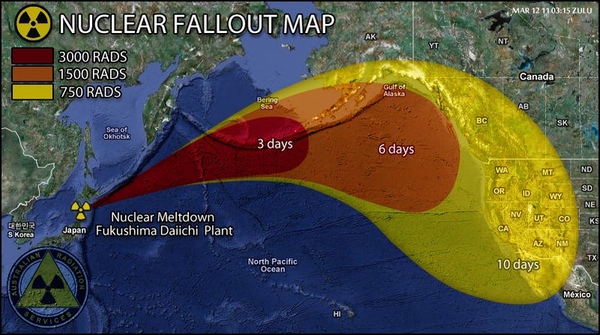
Some Japanese officials have admitted that Tokyo Electric’s Fukushima Dai-Ichi atomic reactor No. 1 may experience a total meltdown. That disaster would be followed by the release of a deadly radioactive death cloud that would drift over the Pacific and poison the people of the U.S. West Coast.
A worried Nuclear and Industrial Safety Agency spokesman Yuji Kakizaki warned:“If the fuel rods are melting and this continues, a reactor meltdown is possible,” Kakizaki said.
A core meltdown of the nuclear pile occurs from an intense build-up of heat Read more…
E. Asia, S. America under tsunami warning after Japan quake
03/11/2011 10:45
Biggest earthquake to hit Japan in 140 years triggers 10-meter tsunami, kills at least 6 people; 4 million homes without power; hotel collapses in city of Sendai, people feared buried in rubble; UN rescue teams on standby.
SINGAPORE – A tsunami warning has been issued for areas across East Asia and the western coast of South America following a huge earthquake that hit Japan on Friday, the Pacific Tsunami Warning Center said.
Among the countries for which a tsunami warning is in effect are: Read more…
“Future War with China”?: New US Bomber Aimed at China?

-[General Gary North, commander of the US Pacific Air Force] has hinted at one of the roles the new bombers might play in any future war with China. He said the key to defeating the new J-20 fighter would be to prevent it ever taking off from its mainland bases. Bombers might be used to attack Chinese airfields in the early hours of a conflict.
$3.7 billion. That’s how much the US Air Force proposes to spend over the next five years developing a new, stealthy, long-range, manned bomber likely specifically intended to penetrate Chinese air defences. The plan, included in the Obama administration’ s 2012 budget, could lead to the production of around 100 new bombers by the mid-2020s — and could significantly tip the Pacific balance of power.
Last week’s bomber announcement marked the continued escalation of the arms race between the United States and China. Since early 2010, China has debuted a new stealth fighter prototype (the Chengdu J-20), brought ballistic anti-ship missiles into service and at least temporarily matched the US in Read more…
Global warming could increase diseases originating from water sources

WASHINGTON (AFP) – Climate change could increase exposure to water-borne diseases originating in oceans, lakes and coastal ecosystems, and the impact could be felt within 10 years, US scientists told a conference in Washington on Saturday.
Several studies have shown that shifts brought about by climate change make ocean and freshwater environments more susceptible to toxic algae blooms and allow harmful microbes and bacteria to proliferate, researchers from the National Oceanic and Atmospheric Administration said.
In one study, NOAA scientists modeled future ocean and weather patterns to predict the effect on blooms of Alexandrium catenella, or the toxic “red tide,” which can accumulate in shellfish and cause symptoms, including paralysis, and can sometimes be deadly to humans who eat the Read more…
Underwater Volcanoes a Hotbed of Clues to Earth’s Movements
 Night view of the JOIDES Resolution, docked in Auckland, New Zealand, before its departure. Credit: D. Buchs, Australian National University.
Nearly half a mile of rock retrieved from beneath the seafloor is yielding new clues about how underwater volcanoes are created and whether the underlying hot spots of molten rock that lead to their formation have moved over time.
Geoscientists have just completed an expedition, part of the Integrated Ocean Drilling Program (IODP), to a string of underwater volcanoes, or seamounts, in the Pacific Ocean known as the Louisville Seamount Trail.
There they collected samples of ocean floor sediments, lava flows and other volcanic eruption materials to piece together the Read more…
New North Korean Space Launch Site Appears Completed
Steve Herman

Photo: GeoEye and Globalsecurity.org
Image taken from the Ikonos satellite, January 10, 2011
New satellite imagery seen by VOA News shows North Korea has completed a launch tower at its second missile launch facility, in the country’s northwest. Intelligence analysts in the United States and South Korea are keeping a close eye on the facility, near Tongchang-dong.
The site is seen as a critical element in Pyongyang’s quest to build a missile capable of delivering a nuclear weapon across the Pacific.
The satellite pictures were taken during the past month. Most significantly, the photographs reveal Read more…
Climate phenomenon La Nina to blame for global extreme weather events

Cyclone Yasi over Australia in February 2011. Image credit: NASA
(PhysOrg.com) — Recent extreme weather events as far as Australia and Africa are being fueled by a climate phenomenon known as La Nina — or “the girl” in Spanish. La Nina has also played a minor role in the recent cold weather in the Northeast U.S.
The term La Niña refers to a period of cooler-than-average sea-surface temperatures in the Equatorial Pacific Ocean that occurs as part of natural climate variability. This situation is roughly the opposite of what happens during El Niño (“the boy”) events, when surface waters in this region are warmer than normal. Because the Pacific is the largest ocean on the planet, any significant changes in average conditions there can have consequences for temperature, rainfall and vegetation in distant places.
Scientists at the International Research Institute for Climate and Society (IRI), part of Columbia’s Earth Institute, expect moderate-to-strong La Niña conditions to continue in the tropical Pacific, potentially causing additional shifts in rainfall patterns across Read more…
Scientists warn of new Chilean quake
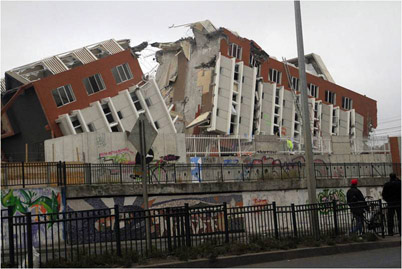
Rescue workers search for victims and survivors after an apartment complex collapsed during an 8.8-magnitude earthquake in Concepcion on February 27, 2010. Scientists say there is a high risk of a new earthquake in an area of Chile's Pacific coast which was hit by a massive quake and tsunamis last year.
Nearly 500 people were killed when an 8.8-magnitude earthquake struck off the coast of central Chile triggering a local tsunami in February 2010.
According to the report published in the journal Nature Geoscience, the previous quake had only partly broken stresses, deep in the Earth’s crust in the Chilean city of Concepcion, that have been building up since an 1835 quake witnessed by British naturalist Charles Darwin.
Darwin documented the 1835 earthquake during a five-year voyage.
“We conclude that increased stress on the unbroken patch may in turn have increased the probability of another major to great earthquake there in the near future,” the report read.
Chile’s February quake was the most powerful since the one in 2004 which caused a devastating tsunami in the Indian Ocean.
“It’s impossible to predict exactly when a new quake might happen,” Stefano Lorito of Italy’s Istituto Nazionale di Geofisica e Vulcanologia told Reuters.
Scientists examined data from tsunamis, satellites and other sources to calculate the Read more…
Flooding, Avalanche Threat Continues Across Northwest
Drenching rainfall from the latest in a series of storms will continue to cause flooding across parts of the Pacific Northwest today.
Another 1 to 3 inches of rain will fall today along the Pacific coast and in the valleys of western Washington and Oregon, including Seattle and Portland. Heavy rain will also douse areas well to the east of the Cascades, across parts of western Washington and Oregon, as well as parts of Idaho.
The rain will fall heaviest during the morning hours before becoming more showery-in-nature by tonight.
Regardless of intensity, any additional rainfall will only exasperate ongoing flooding, which could make for slow travel along the I-5 corridor south to Medford. Motorists should always avoid driving through areas where water is ponding.

Higher rainfall totals are likely in the upslope areas of the Cascades. River flooding is already ongoing along rivers flowing off the mountains, including the Cowlitz, Nisqually and Puyallup Rivers. Read more…


![[Most Recent Quotes from www.kitco.com]](https://i0.wp.com/www.kitconet.com/charts/metals/gold/t24_au_en_usoz_2.gif)
![[Most Recent Quotes from www.kitco.com]](https://i0.wp.com/www.kitconet.com/charts/metals/silver/t24_ag_en_usoz_2.gif)

 crisisboom
 CRISISBOOM

You must be logged in to post a comment.