Archive
McDonald’s using DNA-based security system in Australia

January 18, 2013 –
In an effort to crack down on theft at McDonald’s locations in Australia, the fast-food restaurant chain has hired a British firm SelectaDNA to install a security system that sprays a “non-toxic solution with DNA code” on robbers.
A number of McDonald’s locations in Sydney had been targeted for break and enter by criminals over the Christmas and New Year holiday period. McDonald’s Australian subsidiary hopes the newly installed systems will stop the intrusions.
The SelectaDNA Intruder Spray solution was introduced in 2008 and contains an ultra-violet tracer and a unique DNA code, which “irrefutably” links the sray to the crime scene, according to an online ABC News report. SelectaDNA has currently installed its Intruder Spray Read more…
5 Creepy New Ways for Police to Intrude on Your Rights

As a result, every year the police get more tools, gadgets, weapons, and surveillance technologies that, whatever their stated purpose, serve to give cops greater capabilities to curtail the rights of anyone unlucky enough to be standing in their path.
We were going to list these in order from least to most creepy, but that proved far too challenging. So here are some cop tools you may not be familiar with, in no particular order.
1. Shock-cuffs.These made a splash in late 2012 when it was reported that Scottsdale Inventions had submitted a patent for metal handcuffs capable of Read more…
Big Google is watching you
by Alan Kohler
 While travelling overseas at Christmas we naturally turned off mobile data on our phones to avoid being ripped off by the phone companies’ rapacious data roaming charges.
Instead, everywhere I went I asked for the Wi-Fi password and sometimes didn’t even need one. No problem, although using Google maps to get around in the street was impossible.
In fact with all three phone networks in Australia whacking up their data prices, I’m thinking of turning off mobile data at home as well. There’s more and more public Wi-Fi around and although the domestic Read more…
Startling Statistics on Excessive Video Game Use in Children
 Are you aware of what your child is interacting with? Are you aware of how video games may be affecting your child subconsciously? Too much time on video games and the type of content will affect your child whether you like it or not. Video games holds a big source of debate with some being positive but most is negative. I am not out to ban video games, however, it is critical that parents monitor what their children are doing, watching, and interacting with. Check out this info-graphic below and you will be amazed by its findings….Feel free to tell me what you think.
Intel’s new technology to replace passwords with wave of hand
 The end of passwords?
Intel has developed a new prototype technology which claimed to do away with password for online banking, social networks and email, and instead provide access to them by just waving of hands.
The prototype technology, known as Client Based Authentication Technology, will replace passwords as well as enhance the process for accessing bank accounts, stock portfolios and other cloud-based personal data, Intel said.
Intel researchers have employed the technology in a tablet with new software and a biometric sensor that can recognise the patterns of veins on a person’s palm to access these services.
Claimed to enhance security, the new technology will Read more…
Remote-Control Cyborg Cockroaches
 A Madagascar hissing cockroach sports a wireless electronic microcontroller that allows it to be steered by joystick.
North Carolina State University
Building robots is hard. Making them tiny, maneuverable, durable, and smart enough to find their way around in an unmapped environment—for instance, to find survivors trapped in a building after an earthquake—is harder still. So a team of scientists at North Carolina State has turned to the obvious alternative: remote-controlled bionic cockroaches.
By outfitting Madagascar hissing cockroaches with wireless electronic backpacks and hooking electrodes to their antennae and cerci, the researchers found they could Read more…
Widespread human tracking chips inevitable?
by Mark Lockie
 It may seem like an improbable scenario – and probably is – but new research has revealed growing social unease over electronic tracking technology that monitors workers’ activity, and which may evolve into implants placed directly under human skin.
Professors Nada and Andrew Kakabadse have examined developments in tracking technology already linked to company vehicles and mobile communication devices, alongside employee attitudes towards the prospect of ‘social tagging’ through Radio Frequency Identification (RFID) chips.
Nada Kakabadse commented: “In 2004, the US Food and Drug Administration approved an RFID implant called VeriChip, about the size of a grain of rice, for medical purposes. Nightclubs in Rotterdam and Barcelona already offer implants to customers for entry and payment purposes. Some claim the ‘Obamacare Health Act’ makes under-the-skin (subdermal) RFID implants mandatory for all US citizens.”
Perhaps irrationally (at least in Planet Biometrics’ point of view) study participants thought the Read more…
DARPA “Emergency Response” Robot Runs Faster Than Usain Bolt
Machines to be used for “defense missions”
Paul Joseph Watson
Prison Planet.com
Thursday, September 6, 2012
One of the robots under development by DARPA for the purpose of “emergency response” and humanitarian missions has beaten the human world speed record set in 2009 by athlete Usain Bolt.
“The Defense Advanced Research Project’s (DARPA) Cheetah managed to reach 28.3 mph, said the agency on Sept. 5. The speed is a little faster than the fastest human, Usain Bolt, who set the human world speed record when he reached a peak speed of 27.78 mph in 2009 during a100 meter sprint. The Cheetah robot had already attained the record as the fastest robot on earth when it clocked in 18 Mph earlier in its development,” reports Government Security News.
Cheetah’s advantage versus other robots when it comes to emergency response, humanitarian missions and “other defense missions,” is that it legs enable it to Read more…
Minority Report: Fiction Has Become Reality
“The Internet is watching us now. If they want to. They can see what sites you visit. In the future, television will be watching us, and customizing itself to what it knows about us. The thrilling thing is, that will make us feel we’re part of the medium. The scary thing is, we’ll lose our right to privacy. An ad will appear in the air around us, talking directly to us.”—Steven Spielberg
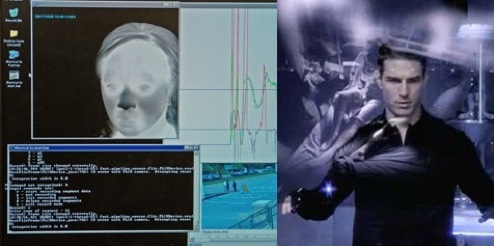 It was a mere ten years ago that Steven Spielberg’s action film Minority Report, based on a short story by Philip K. Dick, offered movie audiences a special effect-laden techno-vision of a futuristic world in which the government is all-seeing, all-knowing and all-powerful. And if you dare to step out of line, dark-clad police SWAT teams will bring you under control.
The year is 2054. The place is Washington, DC. Working in a city in which there has been no murder committed in six years—due in large part to his efforts combining widespread surveillance with behavior prediction technologies—John Anderton (played by Tom Cruise), Chief of the Department of Pre-Crime in Washington, DC, uses precognitive technology to capture would-be criminals before they can do any damage—that is, to prevent crimes before they happen. Unfortunately for Anderton, the technology, which proves to be fallible, identifies him as the next would-be criminal, and he flees. In the ensuing chase, Anderton finds himself not only attempting to prove his innocence but forced to take drastic measures in order to avoid capture in a surveillance state that uses biometric data and sophisticated computer networks to track its citizens.
Seemingly taking its cue from science fiction, technology has moved so Read more…
Op-Ed: Should schools monitor students with ‘spychips’ in student IDs?
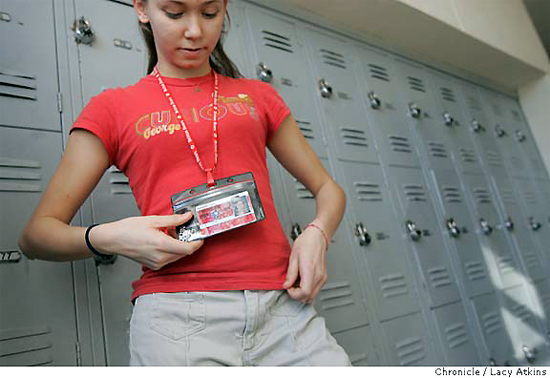 Schools have been tracking student attendance for some time, but the methods of how students are tracked has significantly evolved over the decades. Currently, using “spychips” in schools appears to be an issue that keeps emerging its controversial head.
Technology is available as an easy solution, but is this really the direction society wants to go?
Schools look to “spychips” for student ID cards
The issue of using RFID technology to track students has emerged many times over the past several years. Recently, Digital Journal reported a story where parents and students protestedin San Antonio, Texas after the Northside ISD school district decided to test pilot RFID student ID cards in two of its schools.
The student tracking ID card issue in Read more…


![[Most Recent Quotes from www.kitco.com]](https://i0.wp.com/www.kitconet.com/charts/metals/gold/t24_au_en_usoz_2.gif)
![[Most Recent Quotes from www.kitco.com]](https://i0.wp.com/www.kitconet.com/charts/metals/silver/t24_ag_en_usoz_2.gif)

 crisisboom
 CRISISBOOM
You must be logged in to post a comment.