Archive
Face Recognizing Glasses to be Used by Brazilian Cops
 A small camera fitted to the glasses can capture 400 facial images per second and send them to a central computer database storing up to 13 million faces.
The system can compare biometric data at 46,000 points on a face and will immediately signal any matches to known criminals or people wanted by police.
If there is a match a red signal will appear on a small screen connected to the glasses, alerting the police officer of the need to take further action or make an arrest.
The devices will soon be tested at football matches and concerts and police in Brazil, South America’s biggest country, are already planning to use them Read more…
Giant ocean whirlpools puzzle scientists
 US scientists discovered two giant whirlpools in the Atlantic Ocean, off the coast of Guyana and Suriname. It became a sensational discovery because this part of the ocean has been studied thoroughly, and no one expected anything like that to appear in the area. More importantly, no one can understand where the whirlpools came from and what surprises they may bring to people.
According to Brazilian scientist Guilherme Castellane, the two funnels are approximately 400 kilometers in diameter. Until now, these were not known on Earth. The funnels reportedly exert a strong influence on climate changes that have been registered during the recent years.
“Funnels rotate clockwise. They are moving in the ocean like giant frisbees, two discs thrown into the air. Rotation occurs at a rate of one meter per second, the speed is Read more…
Fires and Drought Trouble Texas and Other US Plains States

Photo: Alberto Tomas Halpern
A volunteer firefighter fights a fire which began outside Marfa, Texas, and was carried by winds to nearby Fort Davis, April 9, 2011
Drought conditions and high winds have fueled destructive wildfires in northern Mexico and the southern U.S. plains states, especially Texas, where dozens of homes have burned in recent days. The dry weather is also having an impact on agriculture that is likely to cause some food prices to rise.
Fast-moving wildfires scorched around 32,000 hectares of land in the west Texas ranch country around Fort Davis on Saturday and Sunday, killing cattle and horses, and leaving pastures charred and smoky. The fires reached populated areas near Fort Read more…
Sea level rises the fastest in 350 years

MELTING mountain glaciers are contributing to the fastest sea level rise in 350 years, according to research by Welsh scientists.
The team from Aberystwyth University, the University of Exeter and Stockholm University undertook a survey of the 270 largest outlet glaciers of the south and north Patagonian icefields of South America.
They mapped changes in the position of the glaciers since the Little Ice Age, which was the last time in the recent past when they were much larger.
The team calculated the volume of ice lost by the glaciers as they have retreated and thinned over the past 350 years and compared these volume losses to rates of change over the last 30 years.
They found that the rate at which the glaciers are losing volume over the past 30 years is between 10 and 100 times faster than the 350- year long-term average.
The study, which has been published in the journal Nature Geoscience, concludes the mountain glaciers have rapidly increased their melt rate in recent years and consequently their contribution to global sea level.
Lead author, Professor Neil Glasser of Aberystwyth University, said the work was based on a longer timescale than any earlier glacier research conducted.
The second author Dr Stephan Harrison of the University of Exeter, said: “The work is significant because it is the first time anyone has made a direct estimate of the sea-level contribution from glaciers since the peak of the Industrial Revolution.”
Deaths and thousands infected with dengue in Paraguay and Bolivia
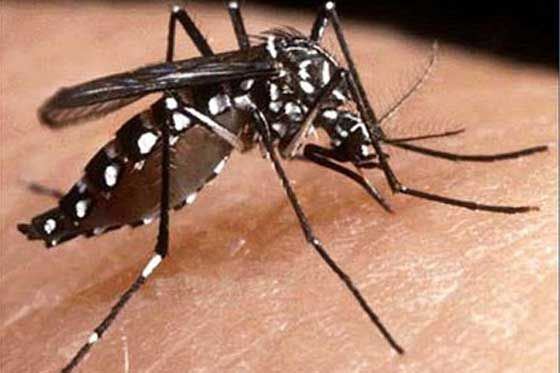
“We have 18 dengue deaths confirmed in Paraguay and 2.500 infected of which 1.300 are hospitalized” said Ivan Allende head of the Sanitary Vigilance Department in Asuncion. He also called on the population to immediately report to a clinic or hospital on suspicion of having contracted the disease, which again reappeared with extreme force in late December with the rainy season.
“In previous years we never had so many people hospitalized” added Allende who indicated that only zero temperatures can help eliminate the mosquito larvae. “Until then we must insist people must collaborate watching out for stagnant water in bottles, old tyres, and flower pots and obviously in toilets and sewage”.
In Bolivia the death toll has climbed to 20 and the number of infected totals 1,670. Read more…
Drought In Amazon Could Lead To Accelerated Global Warming
A new study reveals a drought last year in the Amazon basin caused the forest to lose significant levels of vegetation, which in turn could accelerate the pace of global warming.
The study, conducted by an international team of scientists and funded by NASA, uses specific satellite imaging data provided by the agency to draw its conclusions. The Moderate Resolution Imaging Spectroradiometer (MODIS) and Tropical Rainfall Measuring Mission (TRMM) satellites provided more than a decade’s worth of data for scientists who studied the de-vegetation of the Amazon rainforest.
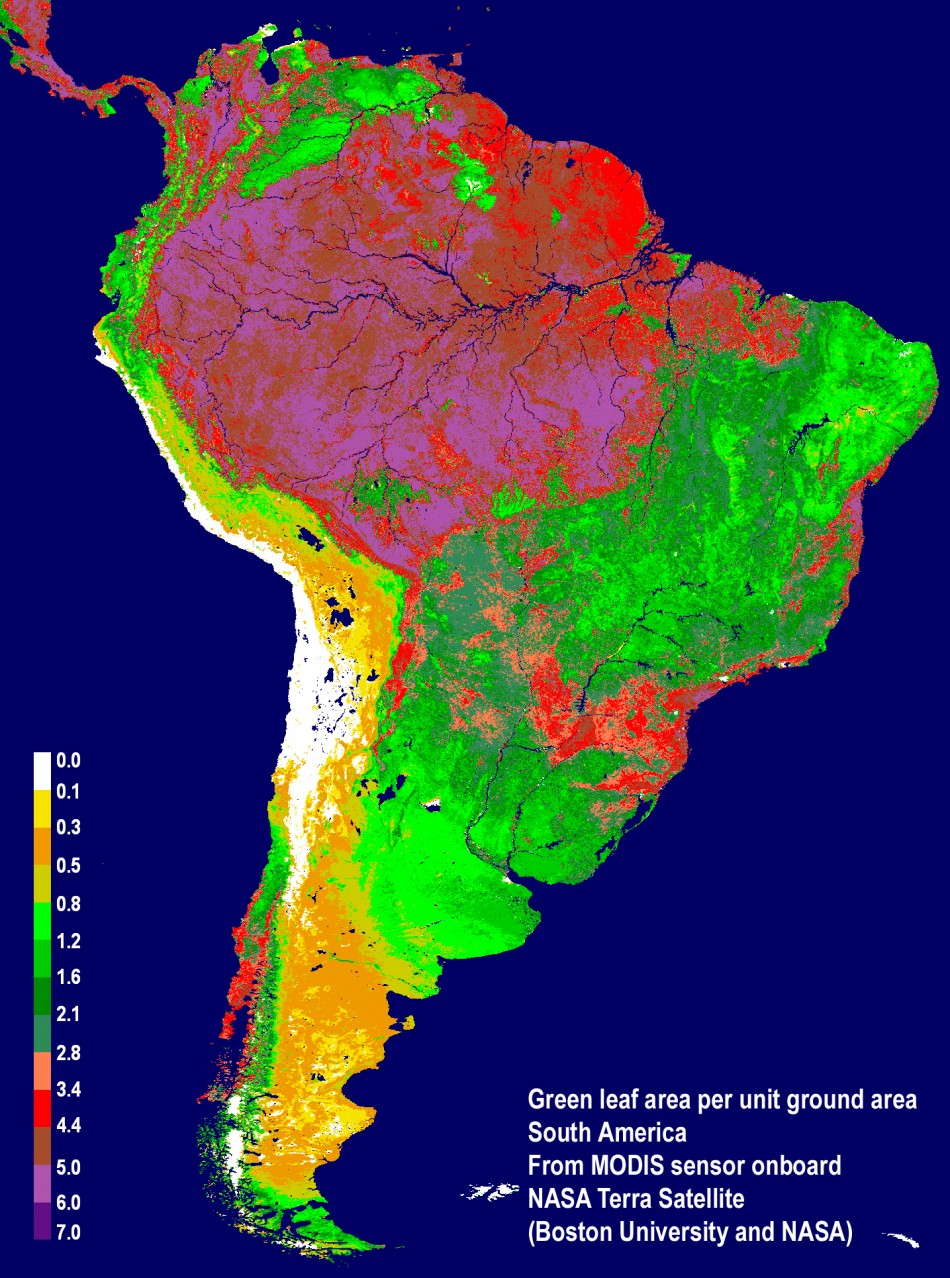
(Photo: NASA/BU) NASA satellite sensors, such as MODIS, showed an average pattern of greenness of vegetation on South America: Amazon forests which have very high leaf area are shown in red and purple colors, the adjacent cerrado (savannas) which have lower leaf area are shown in shades of green, and the coastal deserts are shown in yellow colors.


The scientists say changing climates with warmer temperatures and altered rainfall could lead to the rainforests turning into grasslands or woody savannas. This causes carbon stored in the rotting wood to be released into the atmosphere, which would add to the greenhouse gases present.
“The greenness levels of Amazonian vegetation — a measure of its health — decreased dramatically over an area more than three and one-half times the size of Texas and did not recover to normal levels, even after the drought ended in late October 2010,” Liang Xu, the study’s lead author from Boston University, said in a statement.
“The MODIS vegetation greenness data suggest a more widespread, severe and long-lasting impact to Amazonian vegetation than Read more…
EARTHQUAKE WARNING FROM RUSSIAN INSTITUTE of PHYSICS of the EARTH

A new report released today in the Kremlin prepared for Prime Minister Putin by the Institute of Physics of the Earth, in Moscow, is warning that the America’s are in danger of suffering a mega-quake of catastrophic proportions during the next fortnight (14 days) with a specific emphasis being placed on the United States, Mexico, Central America and South American west coast regions along with the New Madrid Fault Zone region.
This report further warns that catastrophic earthquakes in Asia and the sub-continent are, also, “more than likely to occur” with the 7.3 magnitude quake in Japan today being “one of at least 4 of this intensity” to occur during this same time period.
Raising the concerns of Read more…
Panama Canal rail alternative built by China considered by Colombia
A 136 mile rail alternative to the Panama Canal built by China is being considered by Colombia in a move that would boost trade between Asia and South America.

The ‘dry canal’ would link Colombia’s Atlantic and Pacific coasts by rail, according to Juan Manuel Santos, the president of Colombia.
“It’s a real proposal… and it is quite advanced,” he told The Financial Times. “I don’t want to create exaggerated expectations, but it makes a lot of sense.”
The project is one of several Chinese proposals designed to help boost transport links between the two continents.
It is also hoped the rail link would help encourage the US to ratify a four-year-old free-trade agreement. Agreements with Colombia and Panama, which would Read more…
Stress of Sliding Plates Builds Near Chile

NEAR EPICENTER Concepción, Chile’s second-largest metropolitan area, was badly damaged in last February’s quake.
By HENRY FOUNTAIN
When a magnitude-8.8 earthquake struck off the coast of Chile last February, geophysicists and seismologists were not surprised. The quake’s epicenter was on a roughly 200-mile stretch of a fault where stresses had been building for nearly two centuries, and experts had expected that one day the strain would be relieved in a cataclysmic event.

But as scientists have pored over volumes of data from what may turn out to be the best-studied major earthquake yet, they have concluded that Read more…
Climate phenomenon La Nina to blame for global extreme weather events

Cyclone Yasi over Australia in February 2011. Image credit: NASA
(PhysOrg.com) — Recent extreme weather events as far as Australia and Africa are being fueled by a climate phenomenon known as La Nina — or “the girl” in Spanish. La Nina has also played a minor role in the recent cold weather in the Northeast U.S.
The term La Niña refers to a period of cooler-than-average sea-surface temperatures in the Equatorial Pacific Ocean that occurs as part of natural climate variability. This situation is roughly the opposite of what happens during El Niño (“the boy”) events, when surface waters in this region are warmer than normal. Because the Pacific is the largest ocean on the planet, any significant changes in average conditions there can have consequences for temperature, rainfall and vegetation in distant places.
Scientists at the International Research Institute for Climate and Society (IRI), part of Columbia’s Earth Institute, expect moderate-to-strong La Niña conditions to continue in the tropical Pacific, potentially causing additional shifts in rainfall patterns across Read more…


![[Most Recent Quotes from www.kitco.com]](https://i0.wp.com/www.kitconet.com/charts/metals/gold/t24_au_en_usoz_2.gif)
![[Most Recent Quotes from www.kitco.com]](https://i0.wp.com/www.kitconet.com/charts/metals/silver/t24_ag_en_usoz_2.gif)

 crisisboom
 CRISISBOOM


You must be logged in to post a comment.